Best Saint Patrick's Day upper elementary math activities and fun worksheets
| | |

5 best Saint Patrick’s Day math activities for kids to try this year!

One of the most exciting things about March is that we can help students build a strong fraction operations foundation using themed math activities like St. Patrick’s Day.

If you are working on one of vital foundational skills like fractions or math facts review this post is for you.

In this post, I’m going to share some tips and lesson activities for you to help you learn how to teach fractions and decimal operations in 5th grade in a way that will stick with your students!

So, get ready to sprinkle some leprechaun magic into your math classroom using these 5 best Saint Patrick’s Day math activities for upper elementary students!

Why Teach 5th-grade Math Concepts Using March-Themed Lessons?

Themed activities should not just be fun, but can also bring meaningful practice in classroom learning.

They are the best way to reinforce key concepts when students need extra motivation. They can help you:

  • Builds skill fluency before spring testing season
  • Reinforces key skills through engaging review
  • Helps students apply concepts in meaningful contexts
  • Supports differentiated instruction easily
  • Encourages active participation and discussion
  • Makes practice feel less repetitive

So, if this is something you want with your kids, try out one of these activities:

Saint Patrick’s Day Fractions Operations Worksheets with Word Problems

If you’re looking for a way to support your students with fraction addition and subtraction with unlike denominators without filling up your math centers with boring activities, I have the perfect solution!

I have put together this packet of fraction review worksheets that you can use to review fraction operations that they have learnt this year.
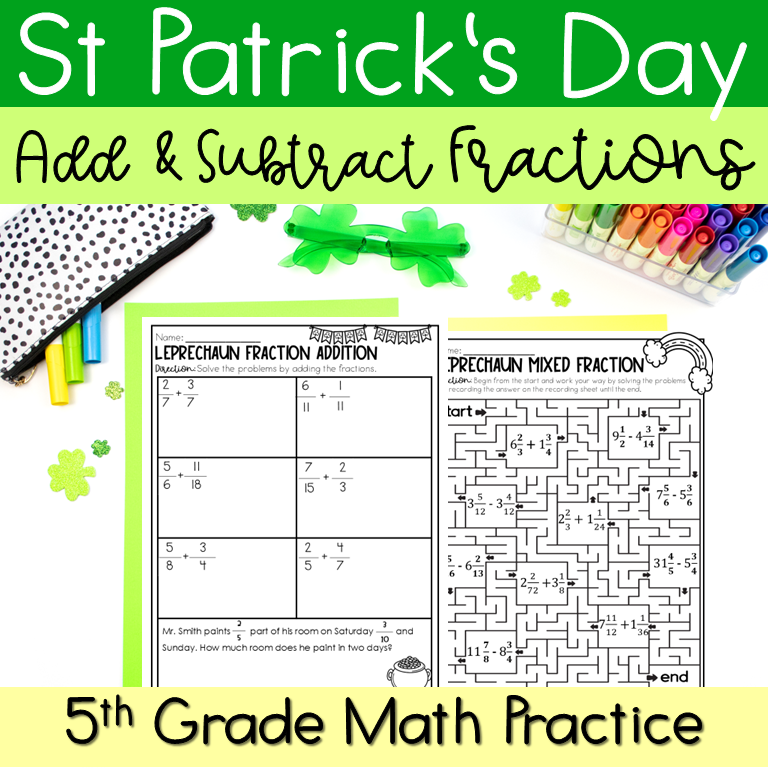
Saint Patrick Day Math Fractions Activities with unlike denominator for upper elementary students

The pack not only includes fraction review worksheets, but also includes self-checking mazes and a word search you can use for the early finishers in your class.

Do not need something to practice, but rather need something to test their knowledge?

The packet also includes 2 pages of multiple-choice question-style worksheets you can use as an assessment to test their understanding.

One thing I love about this packet is that it includes a whole lot of ways I can get them to practice fraction addition and subtraction.

So, whether they’re asked to solve addition and subtraction of fractions, these worksheets will keep them engaged, challenged, and entertained throughout their math journey.

But wait, there’s more! The pack is best equipped with so much more fun like word search and coloring fun.

You can keep a set of these activities copied at your small group table and pull out the most appropriate one you need for each group to try. 

Saint Patrick’s Day Math Coloring Worksheets

These math coloring pages are also a great tool for increasing student independence at centers time or during morning work.

If you are practicing math multiplication or division facts and need them to go beyond and try multidigit multiplication or division, you can do that by using these Saint Patricks activities during their centers.
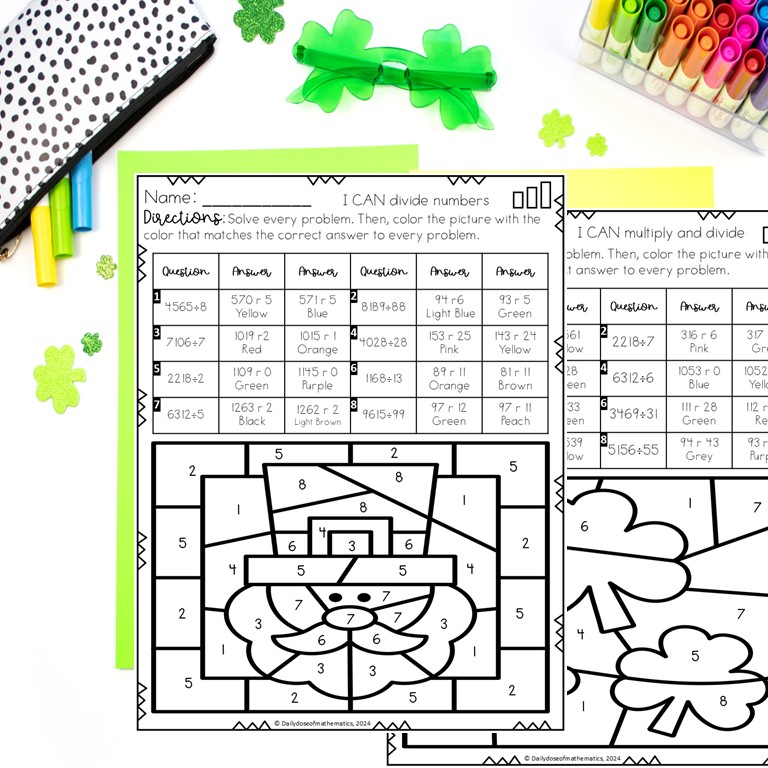
Adding Subtracting Multiplying and Dividing Whole Numbers Coloring Color by Number Activity with Multi-digit Practice

These provide an easy but rigorous practice to help kids be more independent in their basic whole number operations.

So, why settle for boring math practice when you can add a splash of Saint Patrick’s Day magic to your lessons?

Let’s make basic operations like addition and subtraction or even division fun, engaging, and unforgettable with these worksheets!

St Patrick’s Day Decimal Operations Activity

Are your students struggling with adding and subtracting decimals? It might not feel like a difficult skill to you but for 5th graders it’s a lot.

The one concept I have seen students get stuck on is the idea of understanding the decimal place values. They usually align their numbers wrong, which then gives a wrong answer.

So this March, if you want to help kids master decimal operations. Let them practice it in a way that is both meaningful and movement-based.
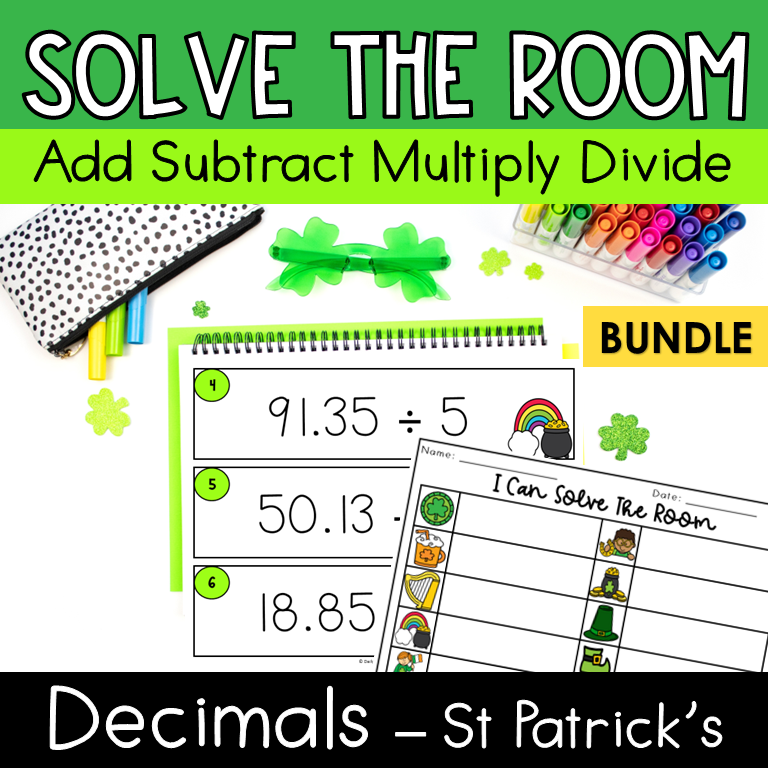
5th Grade Adding Subtracting Multiplying and Dividing Decimals Math Practice Scavenger Hunt and Solve the Room Activity

Saint Patrick’s Day Decimals Solve the Room Activity

Solve the Room activities are similar to scavenger hunts without the self checking part.

Here is how it works:

  • Display the decimal problems inside classroom for kids to find
  • Students navigate the room and solve each problem
  • They engage in active learning, moving, and collaborating with their fellow
  • Record their answer on a recording sheet until all problems are done.
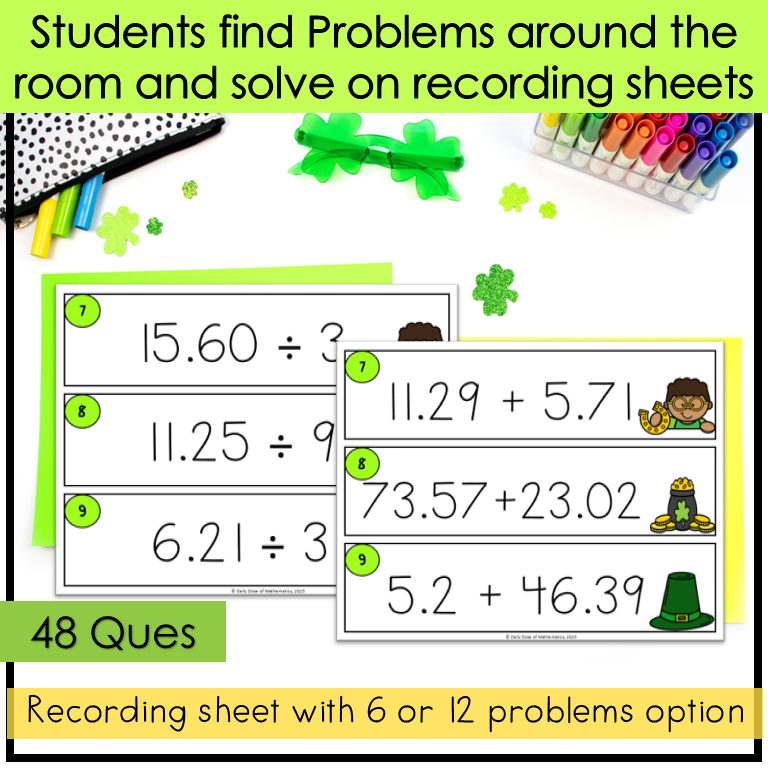
Adding Subtracting Multiplying and Dividing Decimals Math Practice Scavenger Hunt 5th Grade Activity

So, are you ready to turn your classroom into a math-filled treasure hunt this St. Patrick’s Day?

Try these activities and make decimal operations an adventure to remember!

Saint Patrick’s Day Secret Picture Puzzles

For upper elementary students, repetition is key when it comes to learning multi digit multiplication and division.  They need plenty of practice with multiplication math fact fluency before they can master these skills. 

In order to keep students engaged in multiplication and division, you need plenty of activities in our teacher toolboxes! 

That’s why I wanted to share some hands-on March themed activities that your students will love!

If you’re looking for a hands-on way to help students practice multiplication or division, check out this mystery picture activity!
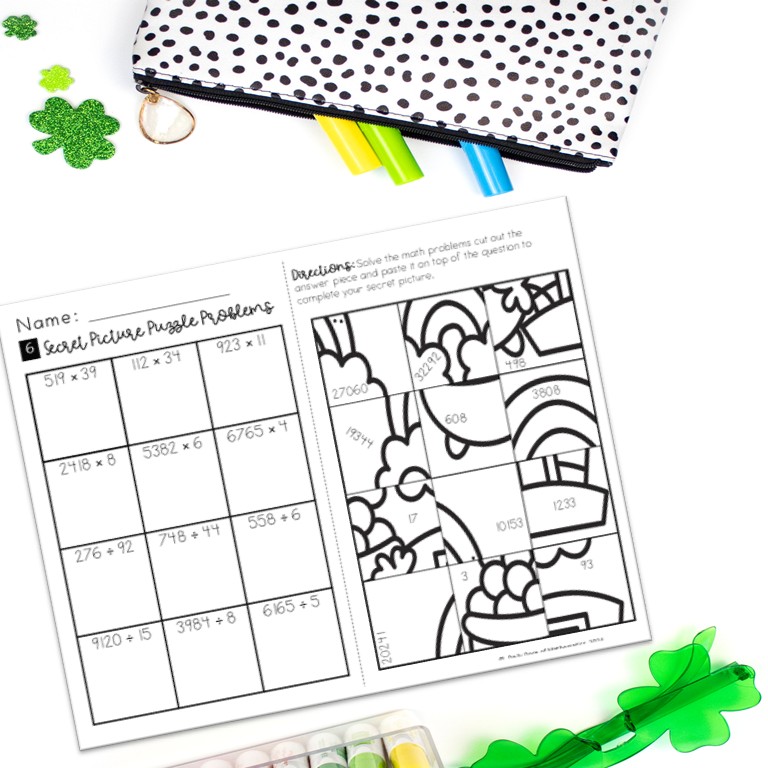
St Patrick's Day Math Picture Puzzles Activity for 4th 5th Grade kids Multiplication and division practice

All you need to do for this low-prep activity is print off the worksheet and cut out the puzzle pieces! You can cut them out yourself, or let your students cut them.  

These secret picture puzzles can be used in many different ways, which is helpful for differentiation and engagement. 

You can use these printable activities for math centers, morning work, small group practice, or even for fast finishers! 

No matter how you decide to use these activities, your students will benefit from the extra practice with multiplication and division!

St. Patrick’s Day Themed 5th Grade Math Craft

Lastly, there are math crafts that are not just fun but also include common core-aligned practice so your students move forward in their math progress.

This fraction math craft activity is perfect for centers because it is self-correcting and rewarding! 

Students solve 3 math problems and come back to you to collect their craft item.
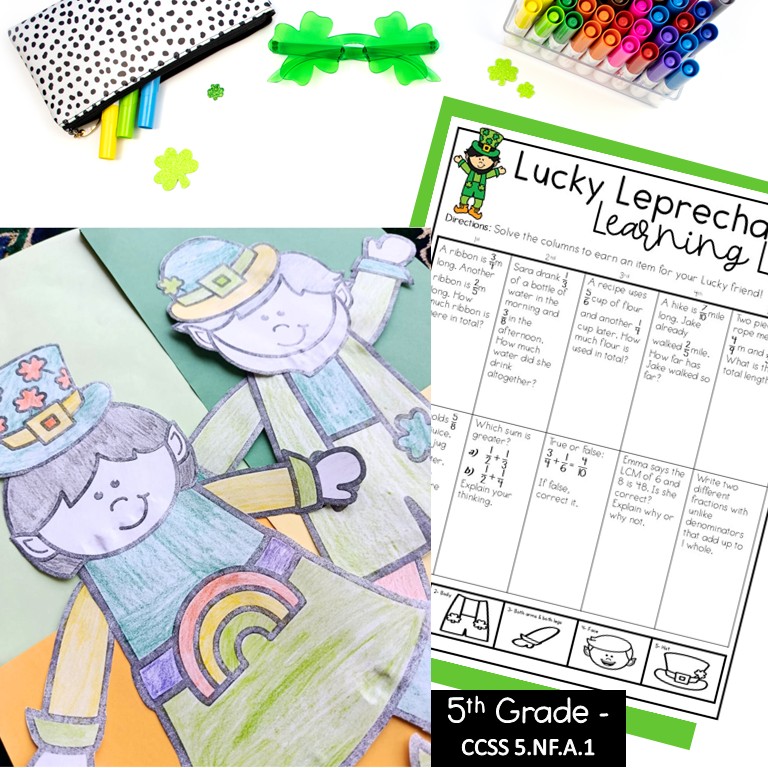
Best St Patricks Day Math Adding and Subtracting Fractions Unlike Denominator Craft 5th and 6th Grade

After checking their answers, the teacher hands them a craft piece that they have earned and will use to build their lucky leprechaun friend.

It’s like a perfect reward-based activity kids need during this time of the year.

Want something fun and free to use in your class check this Free Saint Patty’s day activities!

Want to be set for the whole year of upper elementary math centers without paying your whole teaching salary. Check out this Mega Math Centers bundle currently at 75% off!
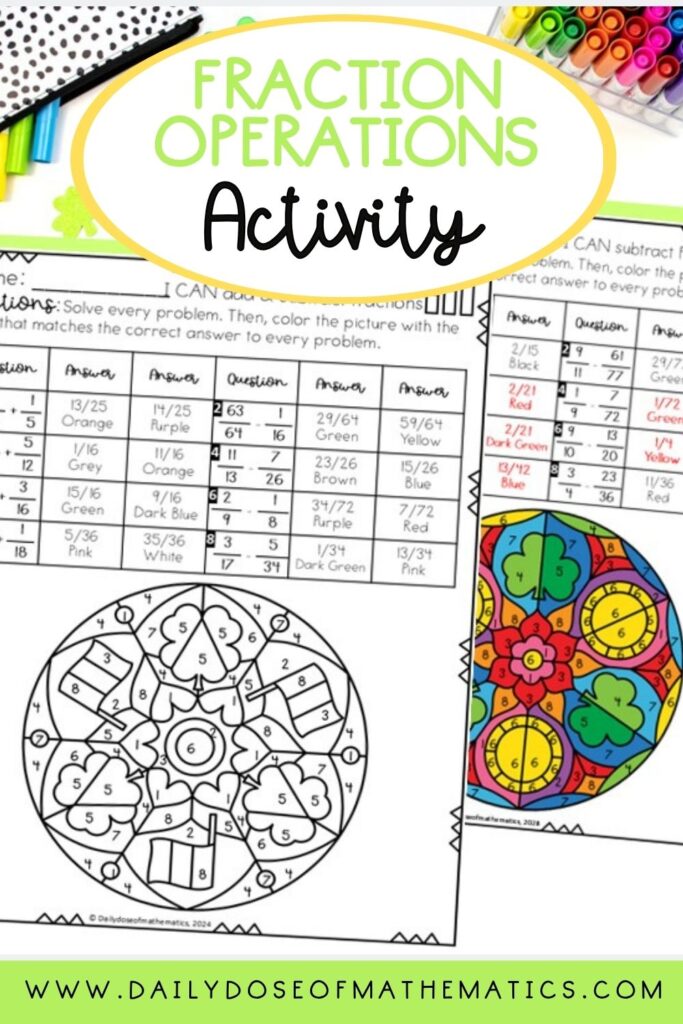
St Patrick's Fraction Color by Number Math coloring activity

Similar Posts

  • 5th Grade Fraction Word Problems That Build Real Understanding

    These fraction word problems worksheets give 5th graders practice applying addition, subtraction, multiplication, and division of fractions to real-world scenarios. The resource also includes an answer key for fast grading.

    Get the them to practice fraction word problems, and don’t miss the free fractions freebie in my resource library for even more practice.

    Teaching fraction word problems in 5th grade can feel frustrating for you and your students.

    You spend time teaching the skills. Students can add, subtract, multiply… maybe even divide fractions just fine.

    But the second those same skills show up in a word problem? Everyone in your class feel like what is this!

    Students just freeze, start guessing, or pick the wrong operation, and suddenly it feels like you’re starting from scratch all over again.

    That’s because fraction word problems require a completely different level of thinking.

    It’s not just about doing the math anymore. Students have to read carefully, figure out what the problem is actually asking, choose the right operation, and solve it step by step.

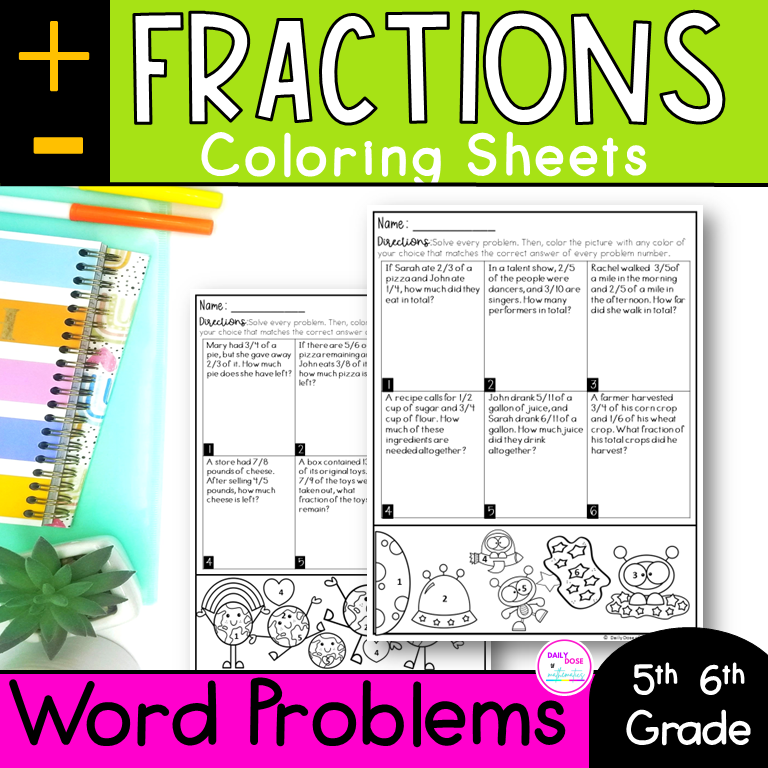
    Fraction 5th grade word problems math coloring activities

    And for a lot of students, especially now a days… that’s a lot to juggle at once.

    The good news is that with the right strategies and a few engaging activities, students can build confidence and start approaching word problems with a lot less frustration.

    In this post, you’ll find practical strategies, classroom-tested ideas, and simple activities to help your students actually understand and solve fraction word problems.

    Why Students Struggle with Fraction Word Problems

    Before jumping into activities, it helps to understand why this is so challenging in the first place.

    Because it’s usually not just one issue it’s a combination of things happening all at once.

    When students work through fraction word problems, they need to:

    • understand what the problem is actually asking
    • decide which operation to use
    • work through multiple steps without losing track
    • and connect the math to a real-world situation

    That’s a lot of thinking just to solve one math problem.

    One of the biggest issues is that students often try to jump straight into solving without fully understanding the question.

    They see numbers and immediately start calculating without stopping to think about what those numbers represent.

    Add in reading comprehension challenges and today’s focus and attention spans, and it gets even harder.

    At that point, it’s not just a math problem anymore it’s reading, reasoning, and problem-solving all combined into one.

    That’s why students who can handle computation just fine still struggle here.

    Get you hands on a Free fractions activity to practice in your classroom today! Signup below:

    Engaging Fraction Word Problem Activities

    Now let’s bring this to life with activities that actually work in a real classroom. Because at the end of the day, students don’t get better at word problems just by seeing more of them they need different ways to interact with the math.

    1. Recipe-Based Problems

    This is one of the easiest ways to make fraction word problems feel real. Instead of abstract numbers, students are working with something they understand food.

    Students might:

    • double or halve ingredients
    • combine fractions while cooking
    • figure out how much of something is needed

    And suddenly, the math has a purpose.

    This is especially helpful for teaching multiplication and division of fractions, because students can actually visualize what’s happening.

    2. Measurement & Real-Life Scenarios

    Another effective approach is using real-world measurement contexts.

    Think length and distance, weight and volume, time and rates. These types of problems help students see how fractions show up in everyday life not just on a worksheet.

    And when students understand why they’re solving a problem, they’re much more likely to stay engaged.

    3. Comparison & Estimation Tasks

    This is an area that often gets skipped but it makes a big difference. Before solving, students should be thinking: “Does this answer even make sense?”. With these types of activities, students learn to:

    • compare fractions
    • estimate reasonable answers
    • explain why something is larger or smaller

    This is helpful to build number sense, which helps reduce careless mistakes and improves their confidence.

    These can also be used during fraction centers or fraction games.

    Signup to get access to 5th grade math resources for free!

    Structured Fraction Word Problem Practice

    If you’ve ever felt like your students are overwhelmed by word problems, it’s usually because they’re being asked to do too much at once.

    One of the most effective ways to fix this is by breaking practice into clear, focused stages. Instead of mixing every skill together right away, build confidence one step at a time.

    Adding & Subtracting Fraction Word Problems

    This is the best place to start.

    Students can focus on understanding the structure of word problems without also worrying about more complex operations.

    Using engaging formats like color-by-number activities can make a big difference here. Students:

    • solve fraction word problems
    • match answers to colors
    • see a visual result as they work

    This keeps them focused longer and gives them immediate feedback, which helps build confidence. This works really well for independent practice, math centers, early finishers.

    5th grade math fractions word problems coloring

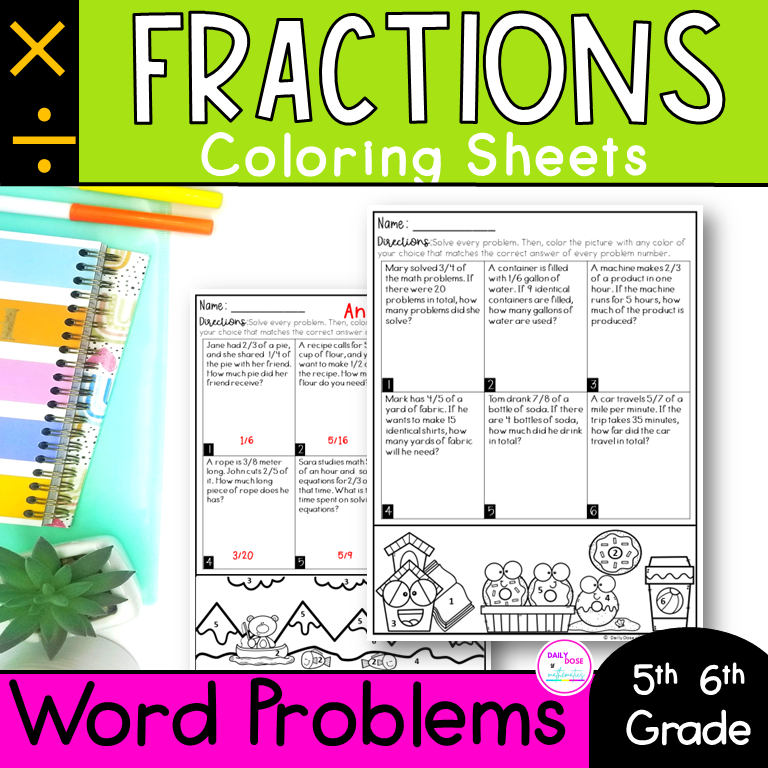
    Multiplying & Dividing Fraction Word Problems

    Once students are more confident, you can move into more complex problems.

    This is where things start to feel more “real-world.” Students need to:

    • interpret situations carefully
    • decide when to multiply or divide
    • work through multi-step problems

    These often include scenarios like scaling recipes, dividing quantities, or comparing amounts, which helps students apply their understanding in meaningful ways. These are great for:

    • small group instruction
    • guided practice
    • test prep
    Multiplying and Dividing Fractions Word Problems Printable PDF

    If you want to take this a step further, you can also set up these activities as rotating stations.

    Want to learn how to run fraction centers in your classroom. Check out this post on 5th grade fraction centers that actually work.

    I’ve also put together a full list of activities you can use throughout your unit: 5th Grade Fraction Activities.

  • | |

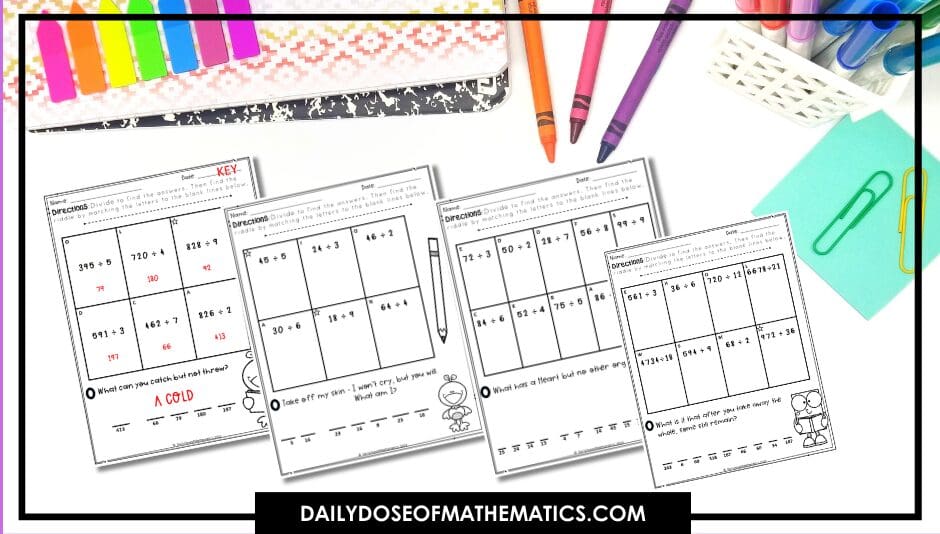
    Fun Division Riddles for Practicing Division Skills

    Division is hard for kids…PERIOD!

    But it doesn’t have to be if its practiced with something fun like riddles.

    Honestly, when I first started out teaching… division always felt like a confusing jumble of numbers because didn’t have their facts memorized. 

    No matter how much you try to make your kids practice division problems unless they have a solid grasp of math facts they won’t be able to work on those complex problems.

    It’s like not knowing how to drive but trying to drive anyway.

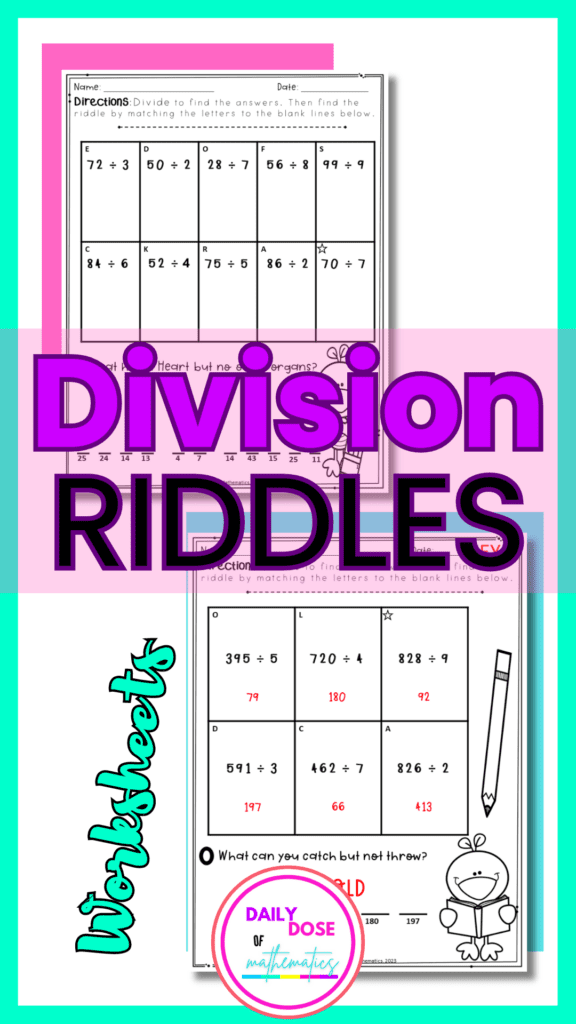
    Division Riddles Worksheets and Activities for 3rd 4th and 5th grade math lessons -Pin

    If that’s the case, then what we should be focusing on is helping them get their basic math facts straight.

    By fifth grade, students should be proficient in basic math facts but if that’s not the case, there’s a problem.

    To be honest, there can be many reasons for this problem. 

    Reasons like

    • a lack of understanding,
    • memorization feeling like a draining task,
    • table overload,
    • multiplication confusion,

    and more can all contribute to elementary kids not having a good grip on facts.

    Are you interested in knowing how I make division practice fun and engaging for my kiddos?

    Without making it seem like they are practicing… It’s by using riddles!

    Riddles are a perfect teaching tool to help students develop division and problem-solving skills during back-to-school time or throughout the whole year.

    Why Division Practice Is Important

    Practicing division problems is crucial for a kid’s basic math learning and understanding.

    It’s like a foundational math skill that helps kids make sense of math.

    When children practice division, they learn how to break things into equal parts and understand the relationship between multiplication and division.

    This reinforces their number sense, basically how they see and work with numbers in daily life.

    It also helps them solve real-world problems.

    Let’s say, they’re cutting a pizza into slices or figuring out how many cookies each friend gets, knowing how to divide makes it easier for them.

    The most important thing is, it opens doors for advanced topics like fractions, ratios, and algebra later on grades.

    Ina nutshell, division helps kids:

    • Increase their problem-solving abilities 
    • Build confidence in handling day to day calculations 
    • Improve their understanding of the world around them

    Now that you know how important it is for our kids to practice division problems. Let’s talk solutions.

    The best way I am able to get my students working on division practice is by using division riddles.

    They keep kids focused on the task at hand and builds perseverance. 

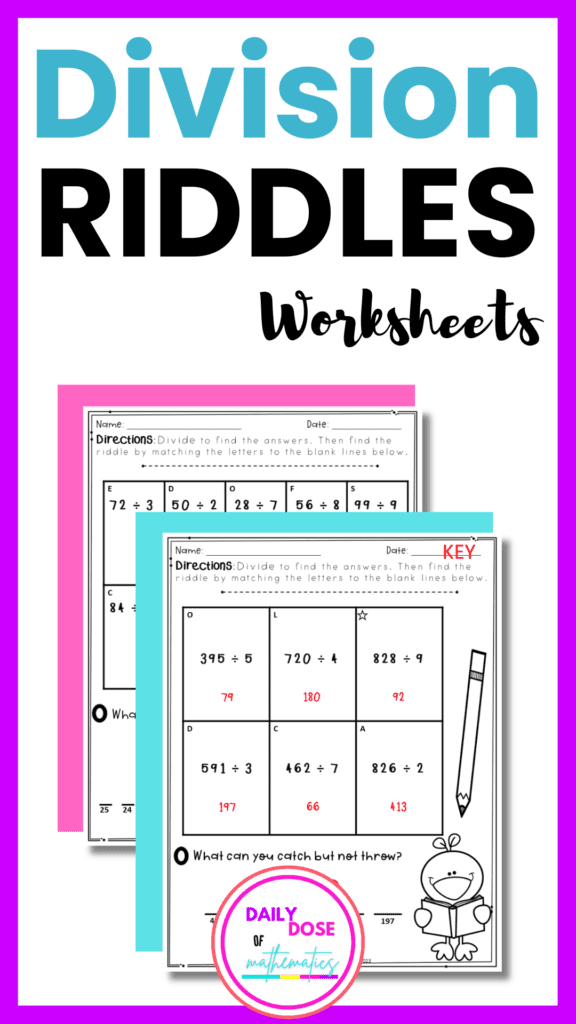
    How Division Riddles Works: 

    You hand out one of the division riddles to your kids.

    It could be a division fact or 2 by 1, 2 by 2  digit or 3 by 1 or 3 by 2 digit, whatever numbers you want your students to practice that day. 

    Students start working on the problems and with every problem they unlock a key (letter) that is part of the mystery riddle they are solving.

    The clues are unlocked randomly to make it more interesting and exciting for the kids.

    Division Riddles Worksheets and Activities 3rd 4th 5th grade elementary kids fun division practice sheets

    Once they have solved all the problems the answer to the mystery is revealed.

    This gamified way of practicing division makes it less intimidating for the students and helps them gain confidence in their math skills.

    Few ways to use Division Riddles inside classroom:

    We all love activities that are versatile and can be used in multiple ways inside our classroom.

    Here are a few ways you can use a Riddle activity 

    • Partner work
    • Home work
    • Centers or rotation
    • Review or practice work
    • Or anytime you want to have something FUN 

    By the way if you are looking for 2 and 3 digit by 1 digit long division practice worksheets for your upper elementary students? 

    Check out the division riddles resource on my TPT shop and let your kids have fun while learning at the same time.

    Division Riddles Worksheets and Activities 3rd 4th 5th grade elementary kids fun division practice sheets-pin

    Looking for more tips on 5th grade math teaching checkout this Blog post on 5th grade year round math activities.

  • |

    How to teach the area of composite/complex figures in an EPIC way!

    Struggling to teach the area of composite figures in a way your students actually get?

    Ever wondered that every time you feel like thinking about how to get started or how even to think about introducing the topic to your kids, frustration kicks in!

    Believe it or not, we all have been there during our first few years of teaching.

    And you’re not alone… If your kids are zoning out the second you say “area” keep reading, this post breaks it down with easy, engaging ideas that make sense (and work for all levels).

    Teach kids how to find Area of Complex or Composite Shapes  figures | middle school math lessons and activities

    Explore the Area of complex figures in an exciting way

    Let’s be real right now teaching math isn’t what it used to be. Today’s kids are growing up with TikTok-level attention spans and infinite entertainment options at their fingertips.

    That means if your area of complex shapes lessons are not engaging and exciting enough, you’ve already lost half the battle.

    Here’s the good news, you don’t need flashy tech or hours of prep work just to make the area of composite figures click for your students. You just need the right strategy.

    So how do you teach this topic in a way that’s fun, clear, and actually sticks?

    find Area of Complex or Composite Shapes lesson math middle school

    The answer: make it visual, hands-on, and connected to real life, yup, that’s right this way your students aren’t just memorizing formulas, they’re solving problems like mini math detectives on a mission hunt.

    Now the question is where do you begin?

    Start with the Basics:

    Like I said, it all starts with basics.

    And to be honest, there is no other answer to this problem other than nailing the basics!

    Here is the hard truth… if kids find the lesson interesting, they are more likely to be engaged and motivated to learn about the problem, think about it, practice it, and ultimately feel a sense of confidence in their skills.

    This is why using gamified methods of teaching math inside your classroom can be a handy tool for teaching any concept!

    Teach kids how to find Area of Complex or Composite Shapes  figures | middle school math lessons and activities

    Seeing Math Everywhere:

    Here are the steps to help kids see math everywhere in their life.

    Step 1: Help Students See Math Everywhere (Real-Life Hook)

    One of the most effective ways to introduce composite figures is by showing students where these shapes exist in their world.

    What it means is to check for there: Activate prior knowledge. Ask your students:

    • What basic shapes do you already know?
    • Can you think of any objects that are made up of more than one shape?

    Then guide them to see that a playground, a building (maybe school) floor plan, or even a weird-shaped pizza is made of multiple simple shapes.

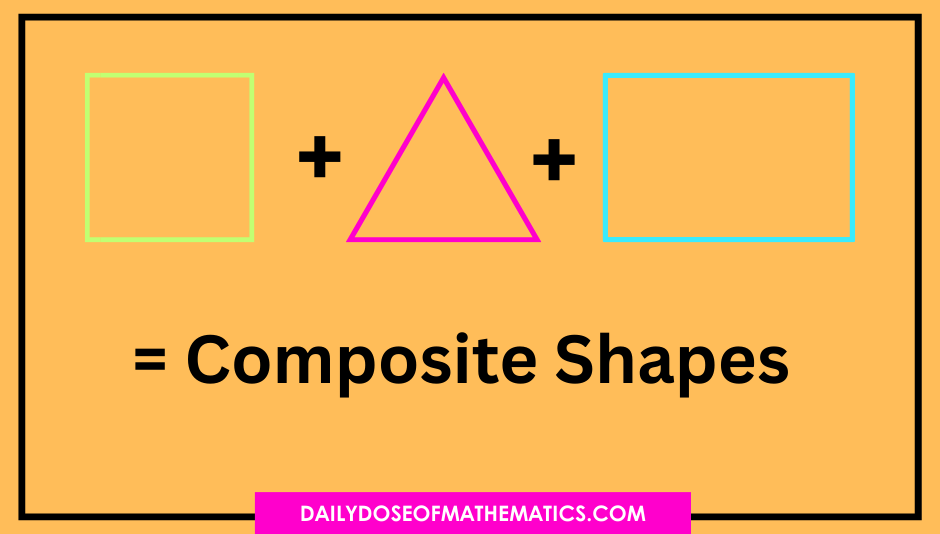
    🟩 + 🟥 + 🟦 = Composite figure.

    Your goal here is to help them realize that composite shapes are just familiar shapes combined, nothing fancy.

    Teach kids how to find Area of Complex or Composite Shapes  figures | middle school math lessons and activities

    Step 2: Revisit the Basics with Hands-On Practice

    Before diving into composite figures, make sure your students are rock solid on calculating the area of:

    • Squares
    • Rectangles
    • Triangles

    Here is a Pro Tip: Use graph paper and have them COUNT squares to confirm what the formulas actually do. This helps your visual and tactile learners “see” the math in action.

    Step 3: Decompose a Composite Figure (using engaging activities)

    Once the basics are solid, it’s time for the real fun, breaking down a complex shape into smaller, manageable parts.

    Here is an activity you can try in your class:

    1. Show them a real-life layout — like a house blueprint or the shape of a playground.
    2. Ask them to identify the basic shapes they see.
    3. Have them outline or color-code each individual shape inside the figure.
    4. Guide them through finding the area of each part — and then adding it all together.

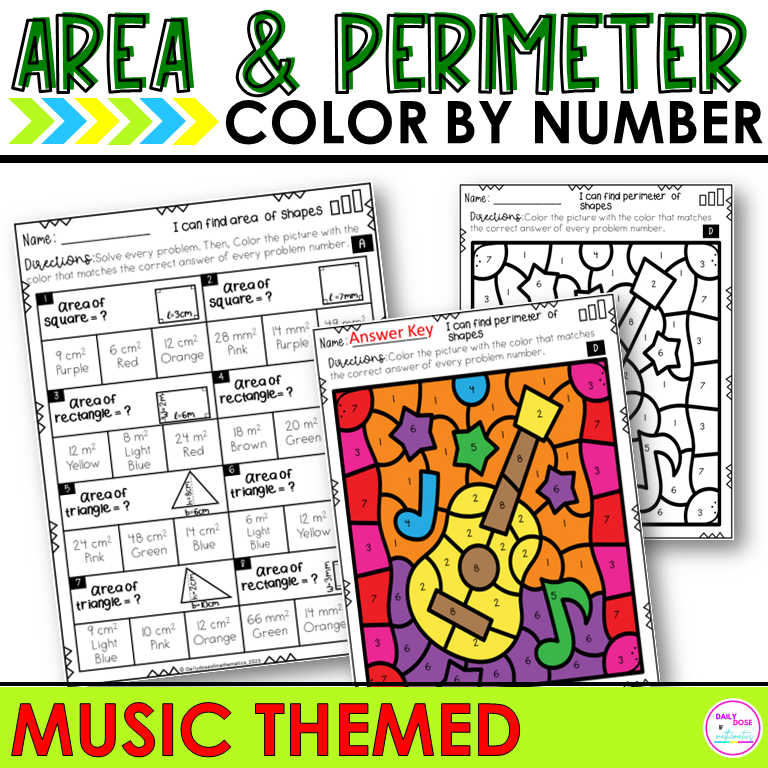
    Want a fun way to reinforce this practice? Try out this this area and perimeter Color by Number activity!

    Finding the Area of Composite Figures or Complex Figures (Color by Number)

    Since kids have already mastered how to calculate the area of regular shapes, it’s time to introduce them to composite figures.

    You can use any composite shape, like a park or a house layout, and ask what they see.

    Tell them to imagine the shape as a whole building made by several small ones and treat every small shape like a rectangle, square, or triangle as a room inside the building.

    Let them think about this concept for a while, and then decompose the shape into its parts and find the area of the individual basic shape.

    Finding Area of Complex Figures Piece by Piece

    Next, it’s time to decompose composite figures like literally breaking the big shape into smaller, familiar parts.

    For better understanding, it’s good to introduce a composite figure with 2 or 3 squares or rectangles and then move on to the more complex figures.

    The next step is to ask your kids how many squares or rectangles they see inside their big figures.

    Have them trace or outline each individual shape in a different color and then calculate the area of each smaller part one shape at a time.

    Pro Tip: Write the area inside each shape as they go to help them see their progress. Next step is to calculate the areas of these individual shapes.

    Since your students by now already know how to calculate the area of regular figures, it would not be a daunting task. Lastly, ask them to add all of them together to get the total area.

    Want some resources to practice the area of squares, rectangles, and triangles in an exciting way? Check out this area and perimeter Color by Number activity below.

    Area of complex figures review practice and perimeter of regular and composite figure, area and perimeter of regular shapes

    Finding the Area of Complex Figures (Trending and Most Popular)

    Now comes the fun part: tell your kids that we are calculating the area of the whole building, not just the single rooms inside.

    They also know how to calculate it by adding the areas of each smaller shape. Basically, by summing up, kids will be able to tell what the area of the complex figure is. 

    Want some fun digital and printable activities to help you with this lesson?

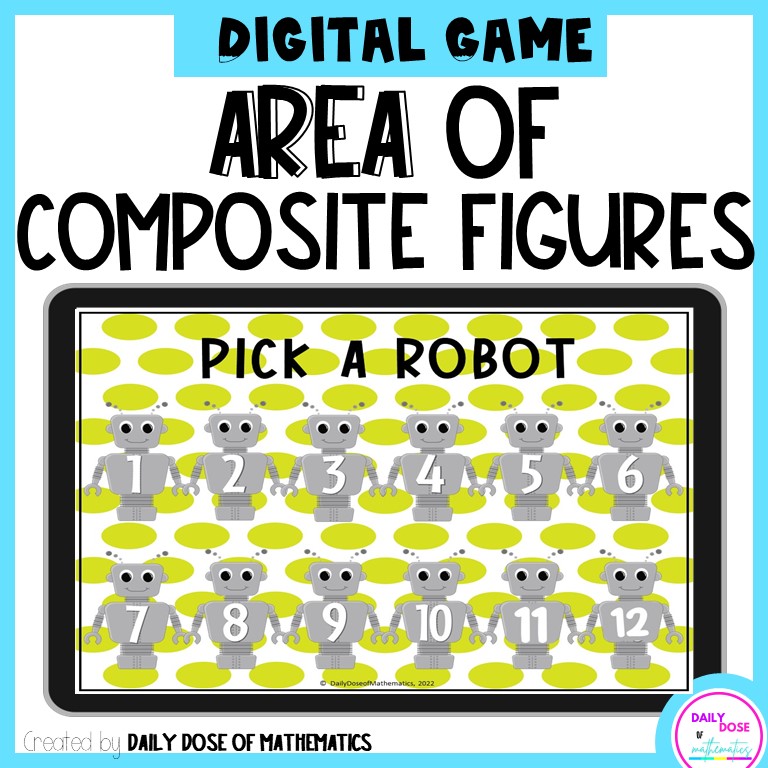
    Check out this exciting whole class activity: Digital game for area of composite figure that also includes printaba le worksheet for student accountability.

    Area of composite figure digital game and activity for 6th grade

    Want to access free math resources worth $29. Click here to learn more!

    Click here to learn more about 5th Grade math activities that keep your students excited while learning math year long.

    Join in to get special FREEBIES and Insider’s FUN!

  • How to Explain Integers and Their Opposites to Students (Without the Confusion)

    If integers make your students’ eyes roll, you’re not alone. Integers and their opposites, especially negative numbers, can feel abstract and confusing.

    This is where students start mixing up subtraction with “opposites” or struggle to see how positive and negative numbers relate. 

    The good news? With the right visuals and activities, integers don’t have to be this overwhelming. 

    In fact, you can make them click for students in a way that actually sticks.

    1. Start with Real-Life Examples

    The fastest way to make integers feel less intimidating in grade 6 is to ground them in everyday life. A few examples that always land with my students are:

    • Temperature: Show how 10° above zero and 10° below zero represent opposites.
    • Elevation: Compare a mountain peak to a cave below sea level.
    • Money: Talk about having $20 in your bank account versus owing $20.

    The goal here is to make the concept more relatable using the example, so the students can connect faster. 

    You can even ask them to share their own examples, maybe like sports scores or video game points going into the negative.

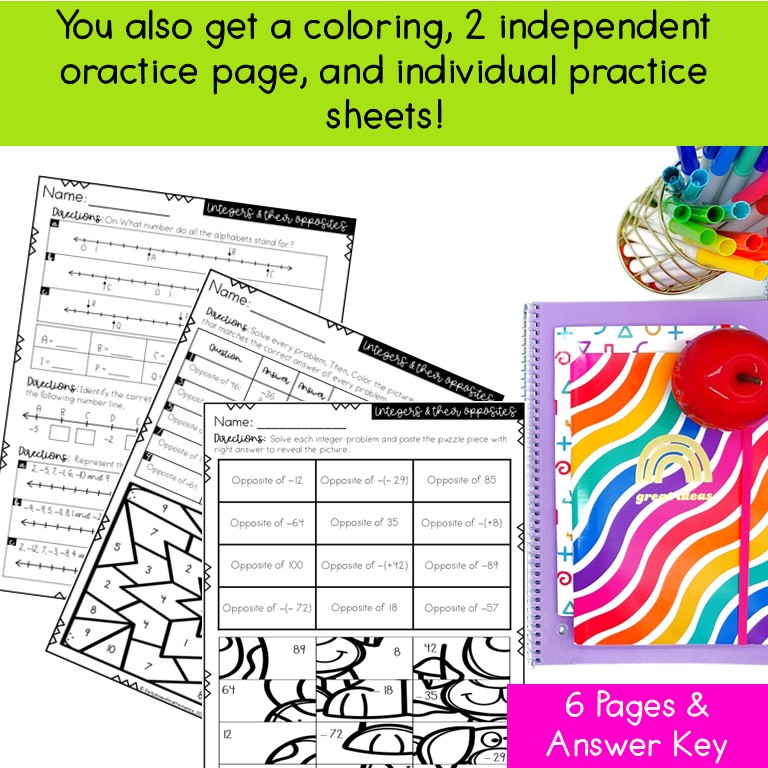
    Integers and Their Opposites activities and pdf worksheets with number line practice

    2. Use a Number Line for Integers and their Opposites

    A number line is the foundation for understanding integers. You should first focus on making sure students understand integers using a number line. 

    When students see numbers laid out visually, they notice the symmetry: every positive number has a negative counterpart that is at the same distance from zero.

    • Highlight how +5 and -5 “mirror” each other.
    • Reinforce the idea that zero is the center, it’s neutral ground, so its negative is also 0.
    • Use visuals (a giant number line taped on the floor works wonders).

    This method makes integers less of an abstract idea and more of a pattern they can see and interact with. 

    3. Introduce Integer Opposites as “Math Twins”

    Kids love simple, fun language. Try describing opposites as math twins:

    • +3 and -3 are twinssame distance, different sides of zero.
    • Use hand motions: one hand moves right, the other moves left.
    • Have students physically “be the numbers” by standing on either side of a taped zero line in the classroom.

    This builds a physical connection, visualizes the concept and gets them out of their seats (which is always a win).

    4. Make it Interactive (Coloring + Games)

    Here is the thing: students learn best when they do. Practicing is the key to success in math. Bring integers to life with:

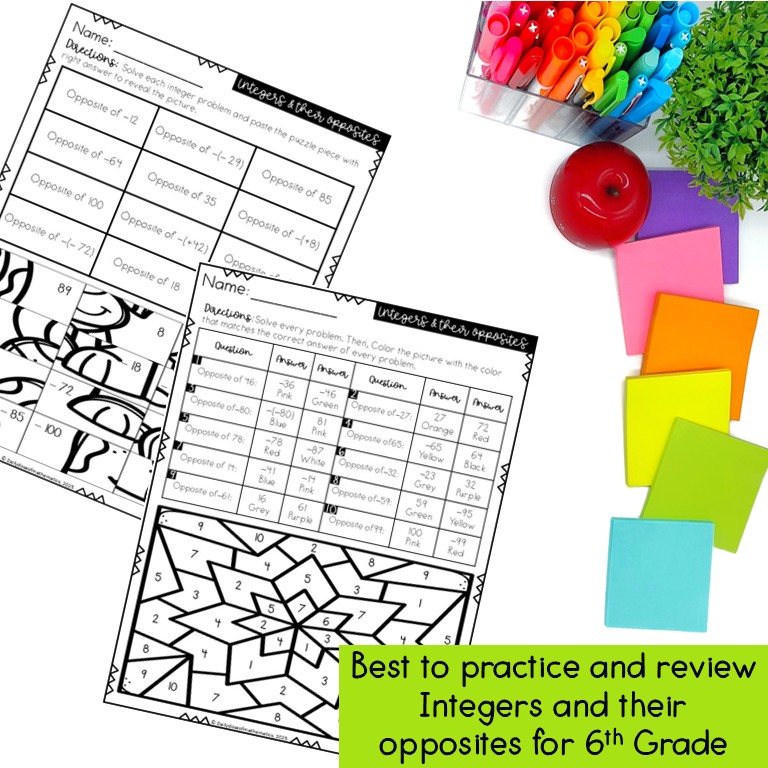
    • Coloring activities where each answer reveals a picture.
    • Matching games: pair positives with their opposites.
    • Scavenger hunts: hide cards around the room and let students find “integer pairs.”
    Integers and Their Opposites activities and pdf worksheets with number line practice

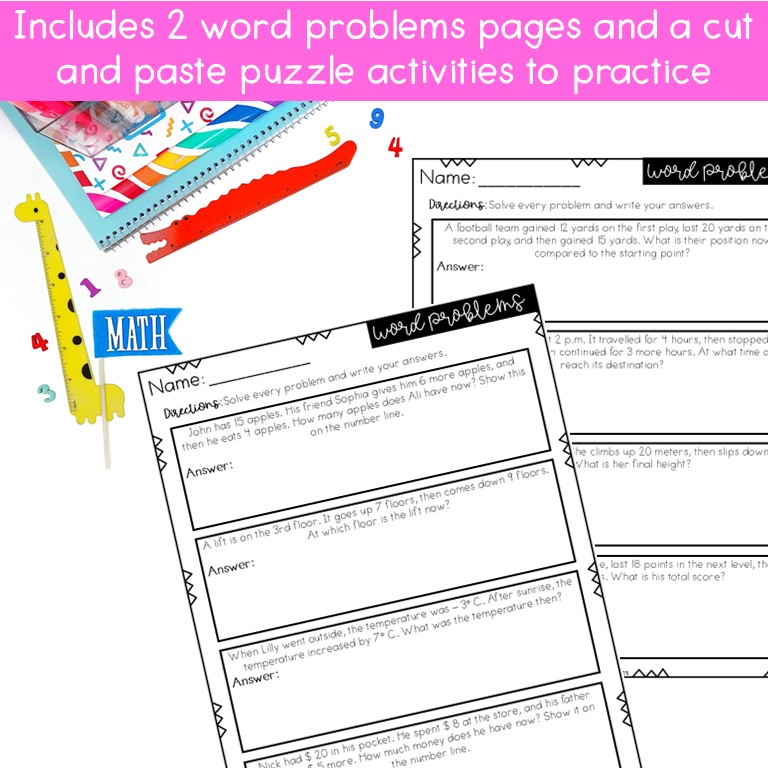
    So if you want a ready to use resource that saves you prep time, I created a set of integer activities and coloring worksheets designed exactly for this concept. 

    They turn practice into a fun activity while reinforcing integer opposites in an interactive way.

    Integers and Their Opposites activities and pdf worksheets with number line practice

    5. Common Mistakes Students Make

    Even after a lot of practice and explaining with strong visuals, some misconceptions pop up again and again: Here is a list of a few that I encounter again anad again:

    • Mixing up subtraction with opposites: For this, clarify that “the opposite of +4 is -4,” but “subtracting 4” is a different operation.
    • Thinking zero has an opposite: Reinforce that zero is its own buddy it has no opposite.
    • Believing negatives are always “smaller”: Explain that while -10 is less than -2, the distance from zero tells us size in terms of opposites.

    Take a few minutes to address these early, and you’ll prevent bigger struggles in later concepts.

    6. Wrap It Up 

    Teaching integers doesn’t have to be a headache for you or your students. 

    By combining real-life examples, number lines, and interactive activities, you’ll help students finally see opposites in a way that sticks.

    Want to save yourself even more prep time? 

    Grab my Integers and Their Opposites Coloring Worksheets on TPT. You can even find interactive activities for GCF and LCM here. They’re ready-to-go, fun for students, and designed to make integers simple instead of stressful.

    And if you’d like even more freebies for your math classroom, join my email list, where I share grab-and-go resources like fraction operations for busy math teachers like you.

  • | | |

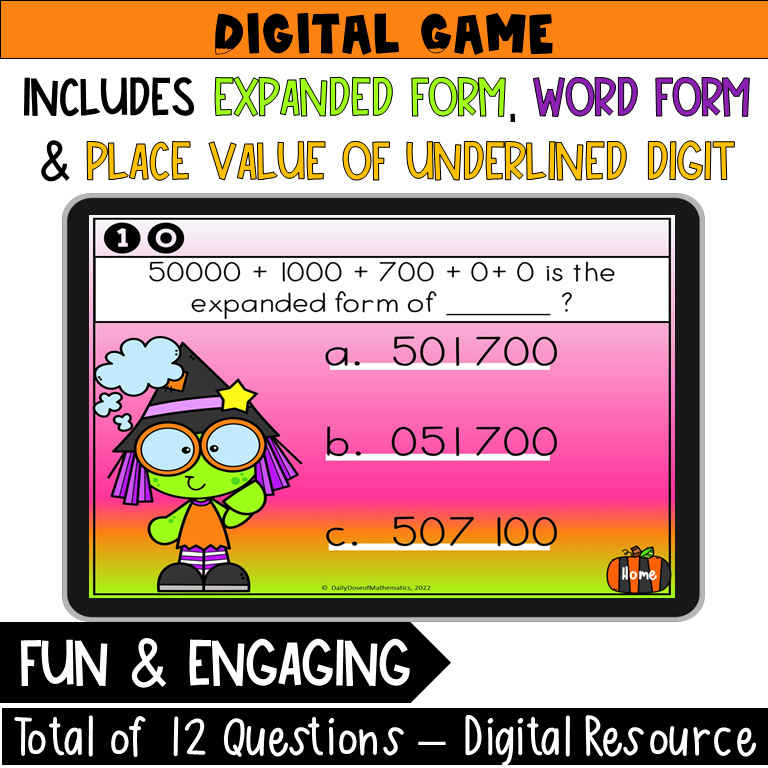
    Fun and Engaging Digital Halloween Math Activities for 3rd 4th and 5th Grade

    Looking for some Fun and engaging Halloween math activities to keep your kids busy? Try out these “PICK A WITCH” Digital Game activities with your class and see their excitement skyrocket.

    This resource is an interactive digital game which you can use to review or assess your kids place value understanding during their centers time or as a whole class activity.

    Halloween math activities for 3rd 4th and 5th grade kids

    Here is how the Game Works:

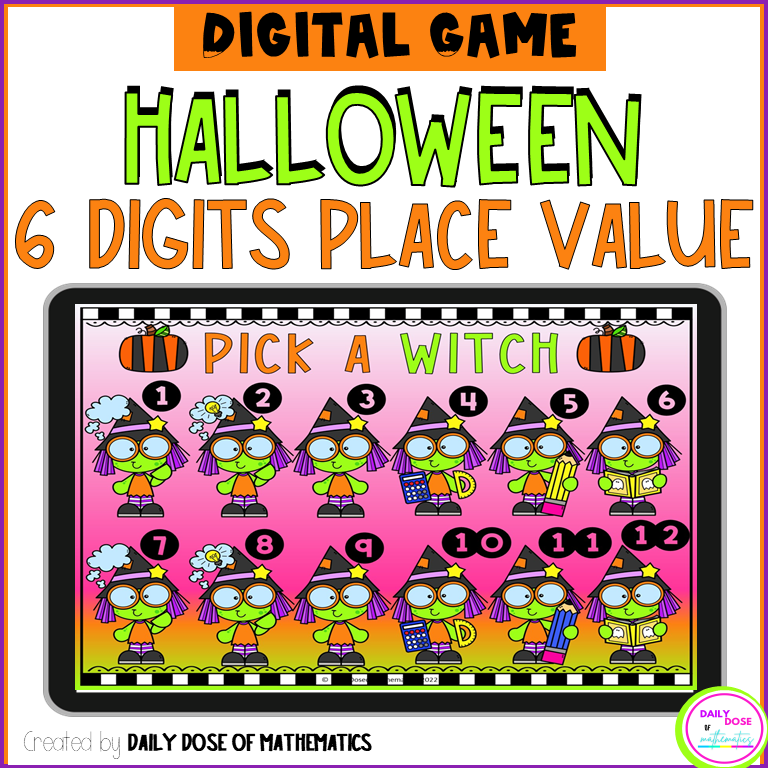
    “PICK A WITCH” Game activity is designed to help your kids practice and review the place value of larger numbers like 6 digits in a fun and engaging way.

    The resource is a compressed file that unzips to a PowerPoint Activity. The Game activity has 12 question slides and 1 main i.e. “PICK A WITCH” slide.

    Display the main slide on the projector and divide your kids into 2 teams. Now tell them to pick a number. The number that they pick you have to click on it to display the question. Once the kids see the question he or she has to answer the question.

    Halloween math activities for 3rd 4th and 5th grade kids

    You can also award 5 score points to every right answer. Once all the questions have been answered by kids. You can add all their scores and announce which team has won.

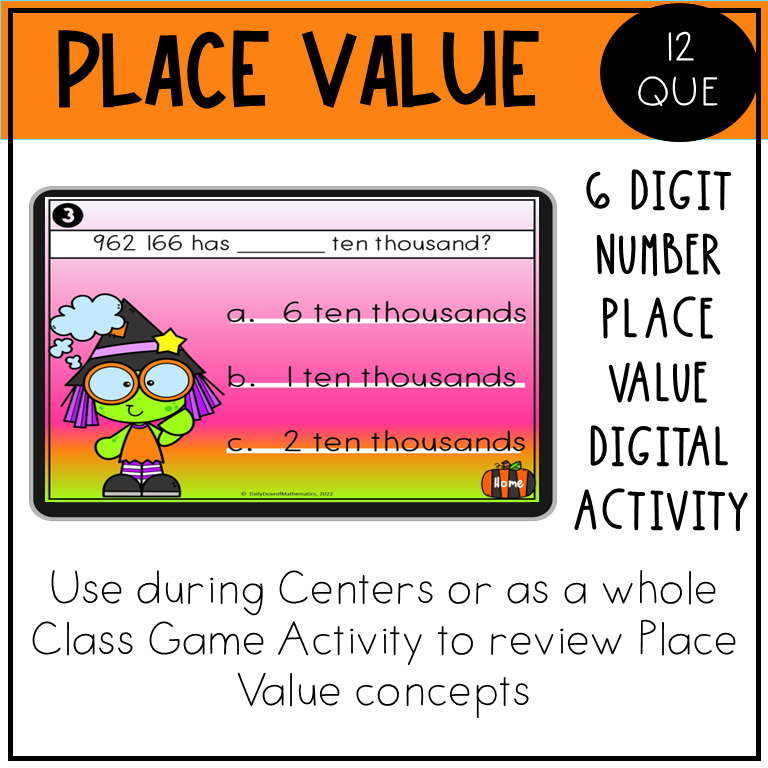
    All the numbers from 1 to 12 on the first slide are clickable and linked to that specific question number slide. There is a Home button on every question slide to access the main Questions slide which makes it an interactive and super fun game that kids enjoy.

    The 12 questions allow you to complete the activity in one go with your class. But it only uses 6 digit numbers. You can use it for fast finishers or as centers digital activity.

    Halloween math activities for 3rd 4th and 5th grade kids

    Oh and just in case if you are looking for a fun and engaging activity to to teach decimals this week, check out Free adding and subtracting decimals activities 5th grade.

    Want more join in for some Insider Fun!


  • | |

    Boost Math Engagement with Fun Fall Themed Interactive Games

    Have you ever found yourself scanning through the room during math class, looking at a mix of bored faces, frustrated sighs, and the occasional doodler?

    I know I have, and we’ve all been there. But the real challenge is making math both fun and educational for kids at the same time.

    This might seem challenging during some teaching days, but what if I told you there’s a way to sprinkle a bit of autumn magic into your math lessons and get those hands eagerly shooting up with answers?

    And yes, that’s possible! The best way to make kids fully involved and ready to solve some problems no matter how hard they are is by using interactive games. 🍂✨

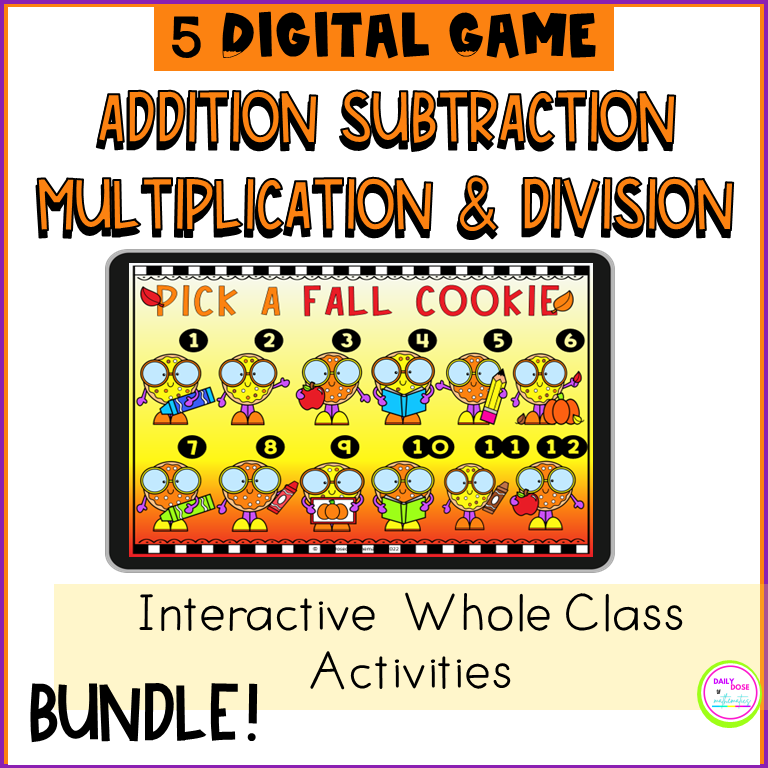
    Enagging Fall addition subtraction multiplication division math powerpoint game activities for 3rd 4th and 5th grade kids

    Use these interactive Fall-themed games in your classroom for small groups during centers or as a whole class activity and see the class engagement soar.

    Here’s Why This Bundle is a Game-Changer:

    • Engagement Overload: With a delightful “Pick a Fall Cookie” Game, learning basic operations like addition, subtraction, multiplication, and division isn’t just another math lesson. It’s an experience. One where students eagerly click through questions, challenging themselves and having a blast while at it.
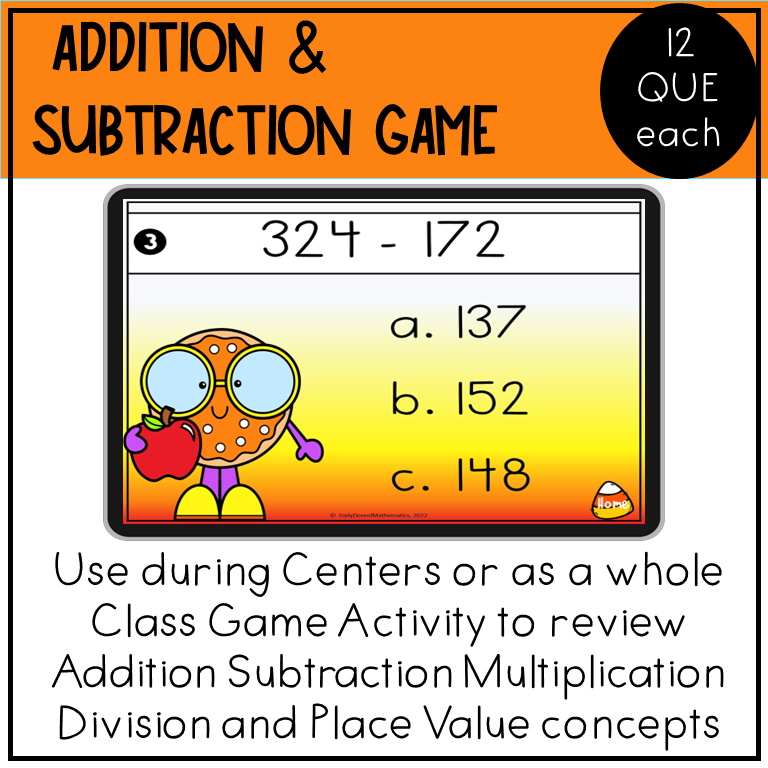
    • Comprehensive Coverage: This bundle isn’t just about practicing a single concept like division. Oh no! Your students will dive deep into 3 digit addition and subtraction with regrouping, tackle 3 by 1 and 2 digit division, and master 2 by 2 digit multiplication. It’s a math smorgasbord!
    • Perfectly Structured: Each game comes with 12 questions, allowing for a full, immersive session without dragging it out. Plus, navigation is a breeze with interactive features like clickable numbers and a handy home button.
    • Versatility: Whether you’re looking to jazz up your math centers, provide engaging activities for early finishers, or differentiate your instruction, this bundle has got you covered.

    What you get:

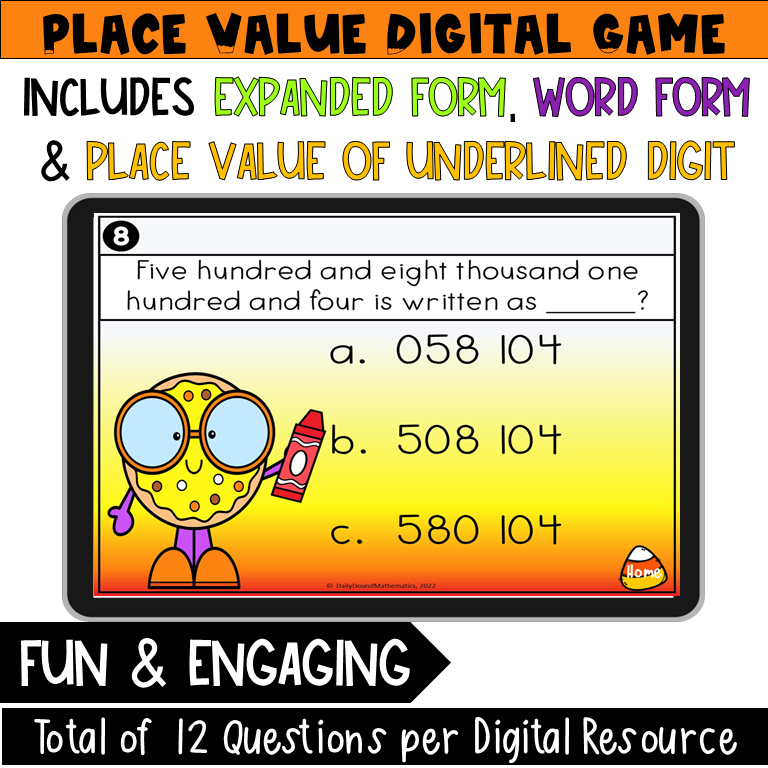
    Once you get this fall interactive games bundle, you’ll find a series of PowerPoint games designed to keep kids engaged in learning addition, subtraction, multiplication, and division, along with 6 digit number place value practice. The goal? To make math engaging, interactive, and the highlight of your students’ day.

    The main slides have interactive numbers with fun and exciting fall images that students can click on and go to that specific slide to solve. 

    Enagging Fall addition subtraction multiplication division math powerpoint game activities for 3rd 4th and 5th grade kids

    Conclusion:

    So, if you’re ready to transform those groans into grins and make math the highlight of your kid’s day, try these fall addition, subtraction, multiplication, division and place value bundle and see your kid’s engagement and confidence soar.🍁📖🍪

    Try these math fraction activities if you want more fun and excitement in your classroom.

    Want to get free stuff sent straight to your inbox?

    Sign up below to get access to Free Resource Center!