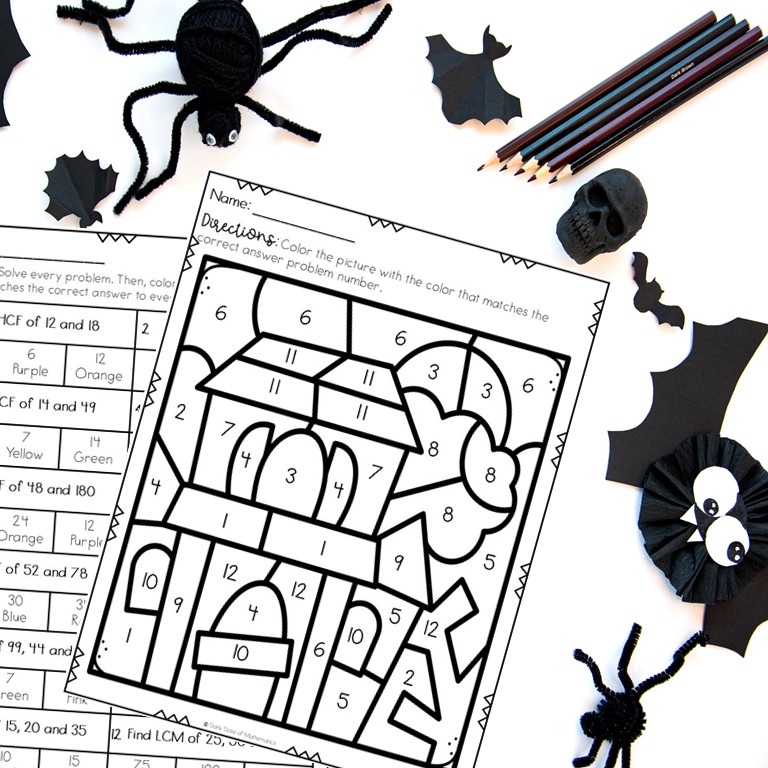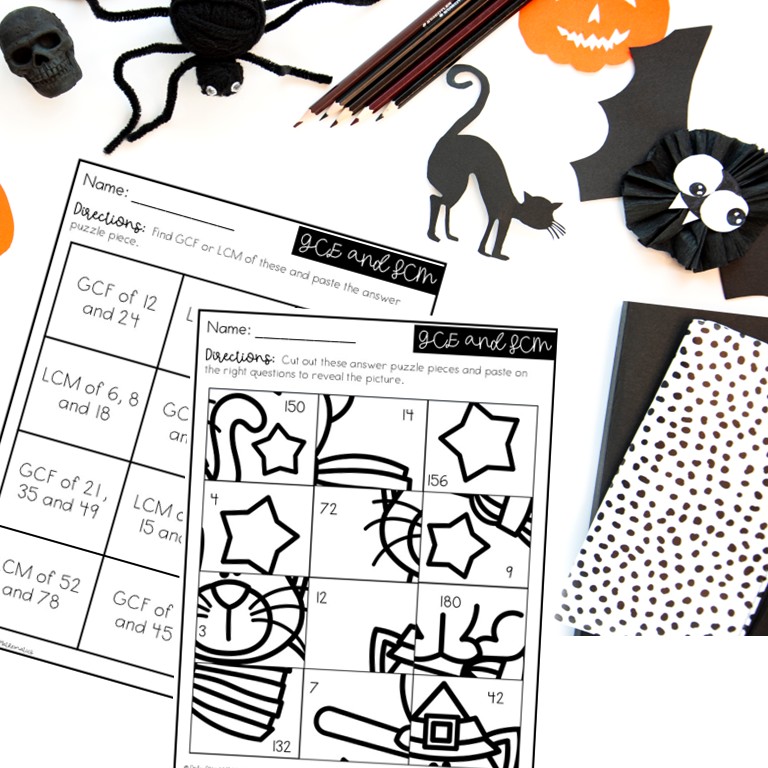
Thanksgiving GCF and LCM Coloring Worksheets and Riddles Activities 6th Grade PDF with Answers
| |

Keep Students Engaged with These Thanksgiving GCF and LCM Worksheets (Includes Answers!)

The week before Thanksgiving is pure chaos in most middle school classrooms.

Students are hyped about the holidays, focus levels drop, and teachers (yes, you!) are juggling lesson plans, grading, and trying to keep the class calm.

That’s where seasonal resources come in.

Thanksgiving GCF and LCM worksheets with answers aren’t just a cute idea they’re a strategic teaching tool.

They combine review and engagement so your students practice key math concepts without tuning out.

In this post, we’ll walk through what GCF and LCM are (with examples), why themed math activities work so well, and where you can grab high-quality Thanksgiving worksheets that save you time. But before that let’s first try to answer:

What Is GCF and LCM (with Example)?

Before diving into Thanksgiving math fun for 6th grade math, let’s make sure we’re all on the same page, especially if you’re prepping sub plans or review material for your students.
Thanksgiving GCF and LCM Worksheets and Activities Grade 6 PDF with Answers

Thanksgiving GCF and LCM Worksheets and Activities Grade 6 PDF 1

Thanksgiving GCF and LCM Worksheets and Activities Grade 6 PDF 1

GCF stands for Greatest Common Factor.
It’s the largest number that divides evenly into two or more numbers.

LCM stands for Least Common Multiple.
It’s the smallest multiple that two or more numbers share.

For example:

Let’s find the GCF and LCM of 27 and 45.

Step 1: List the factors.

  • Factors of 27 → 1, 3, 9, 27
  • Factors of 45 → 1, 3, 5, 9, 15, 45

and here GCF = 9, because it’s the largest number both have in common.

Step 2: List the multiples.

  • Multiples of 27 → 27, 54, 81, 108, 135, …
  • Multiples of 45 → 45, 90, 135, …

Therefore, LCM = 135, because it’s the smallest number both share.

When students practice this repeatedly, they start to recognize patterns and that’s exactly what this Thanksgiving GCF and LCM worksheets with answers help reinforce.

Why Use Themed Math Worksheets Around Thanksgiving?

Because engagement matters.
Thanksgiving GCF and LCM Worksheets and Activities Grade 6 PDF with Answers

When math review looks like just another worksheet, students mentally check out.

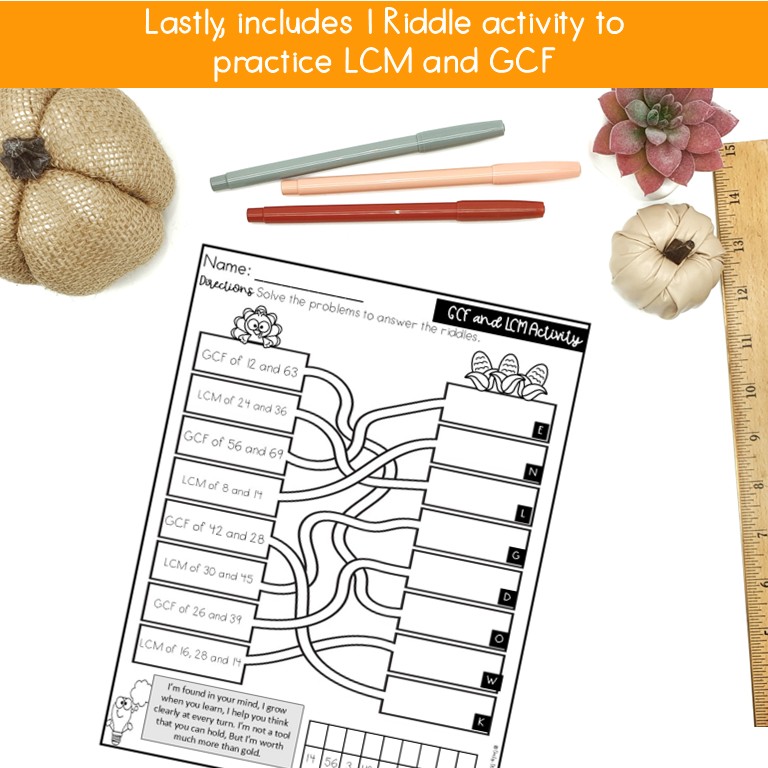
But throw in a Thanksgiving theme a turkey to color, a riddle to solve, or a math puzzle with a seasonal twist, and suddenly, they’re in it.

These worksheets focus on multiple learning styles at once:

  • Visual learners connect with coloring and design-based activities.
  • Hands-on learners enjoy puzzles and cut-and-paste components.
  • Auditory learners can explain their reasoning as they check answers with peers.

Plus, when the activities include built-in answer keys, it saves you (and your sub) valuable grading time.

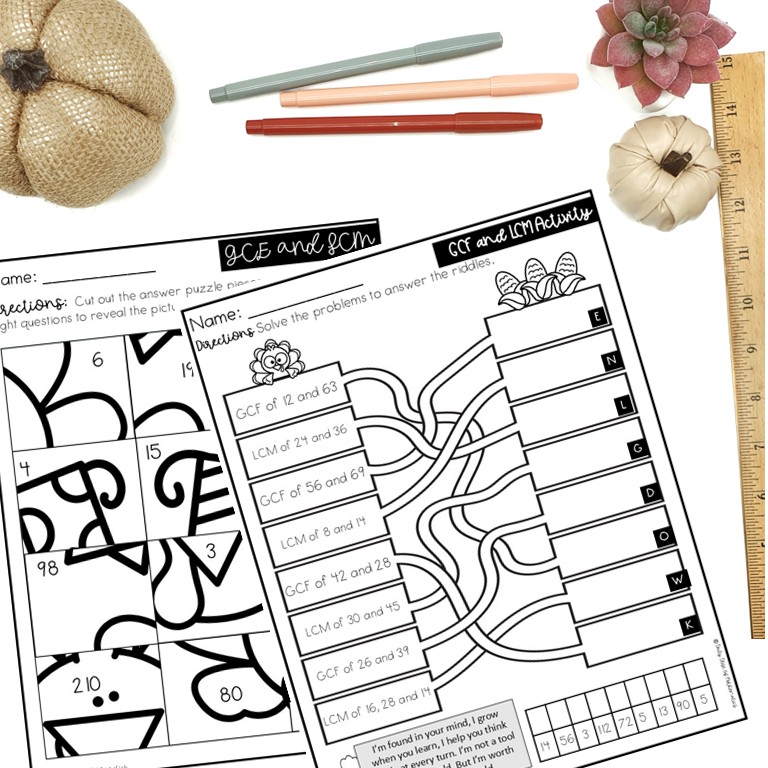
Inside the Thanksgiving GCF and LCM Worksheets

If you’ve been searching for a no-prep, ready-to-go way to review factors and multiples, this set is exactly what you need.

Here’s what’s inside:

  • Engaging coloring activities that make abstract concepts visual.
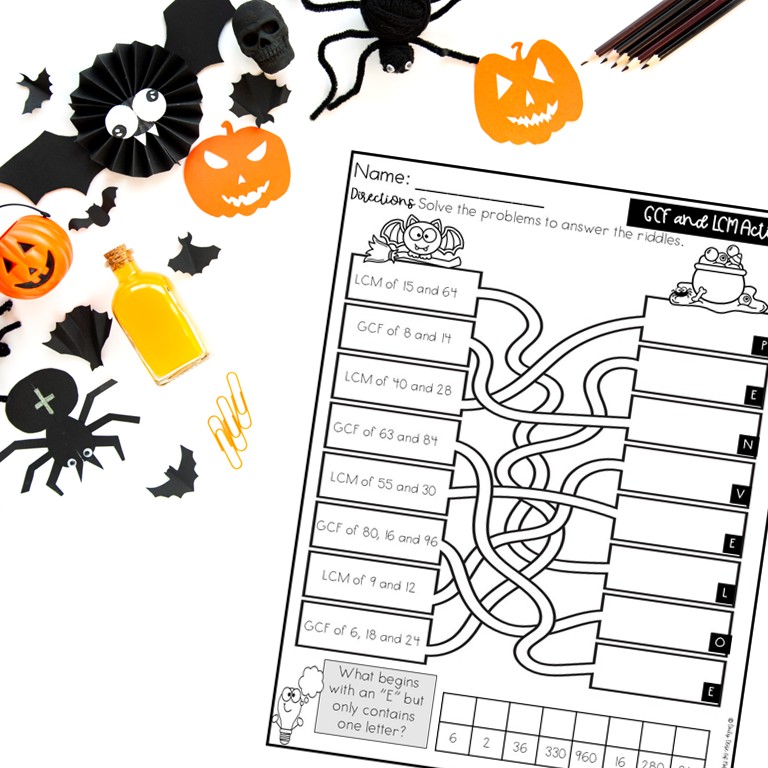
  • Riddles and puzzles that apply GCF and LCM to real-world-style problems.
  • Cut-and-paste practice for reinforcing math patterns.
  • Answer keys included for quick grading and student self-checking.
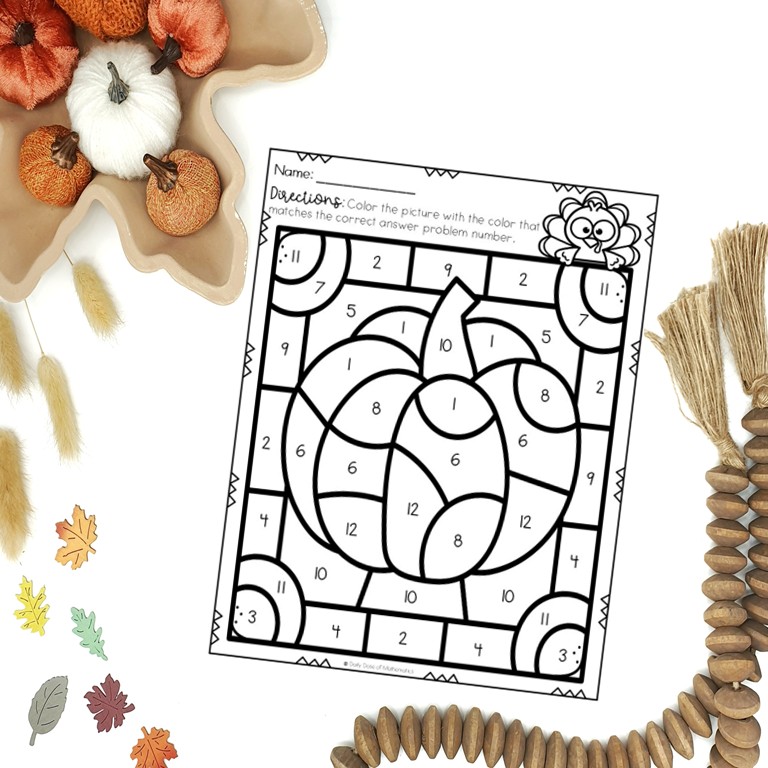
Thanksgiving GCF and LCM Worksheets and Activities Grade 6 PDF with Answers

Check out these Thanksgiving GCF and LCM worksheets with answers pdf and make your pre-break lessons actually enjoyable.

Honestly themed math lessons don’t have to be fluff.

Done right, they can reinforce real math skills and give you a breather during the busiest time of the semester.

So the next time you hear, “Do we have to do math today?”, you can smile and say, “Yup but it’s Thanksgiving style!”

Your students stay engaged, you stay sane, and everyone wins.

Check out Thanksgiving GCF and LCM worksheets pdf with answers and make this year’s holiday math review something your class actually looks forward to.
Similar Posts

  • | |

    Ultimate 5th Grade Fraction Activities for Double Engagement (Including Word Problems, Games & Centers)

    Teaching fractions can feel like a constant struggle, especially in 5th grade. Students need to work hard on their fractions and decimals skills to become fluent in these areas.

    But here’s the good news: the right activities can completely change how students understand and engage with fractions.

    So if teaching fractions feel like a constant struggle or your students lose interest halfway through the lesson… fret not because you are not alone.

    In this post, you’ll find easy and engaging 5th grade fraction activities, including games, movement-based tasks, and hands-on practice that help students build confidence and actually enjoy learning fractions. So, let’s dive in.

    1. Fun Unlike Fractions Games

    One of the most important steps in teaching fractions to upper-elementary students is to make them meaningful. 

    This starts with making sense of what fractions mean and why it is important to make the denominators the same before solving any fraction operations.

    From what I know, by grade 5 the majority of students are fluent in multiplication facts. So solving unlike fractions is just a matter of practice for them.

    What better way to practice than using Games?

    Games are a powerful way to practice and review any skill as it combines repetition, motivation and low-pressure learning opportunity for students.

    If you are looking for some unique fractions game ideas to implement in your classroom, here is one I would suggest.

    5th grade fractions with unlike denominators games and activities

    This activity includes a printable self-checking game maze that you can use with your kids to have them practice addition, subtraction, multiplication, or division of fractions with unlike denominators.

    Each fraction operations maze activity comes with 12 task cards and a self-checking fun game, which keeps kids inspired to learn without you having to spend all day grading.

    The game is story-based, in which your kids become detectives, helping the Queen bee, who is lost in the jungle, return home.

    For that, your kids have to work through the problems and move through the maze to bring her back home.

    Once the kids have completed the activity, you can use the printable reward card to reward your kid’s hard work and create a positive motivation for them to practice their math skills happily the next time!

    Want a free activity to practice fraction skills? Click here to join the community today.

    2. Fractions Centers Activities

    Math centers are one of the easiest ways to bring structure and engagement into your classroom.

    An important part of keeping your math centers engaging and exciting is rotating the learning materials that the students can use during centers.

    Here are a few of my favorite fraction centers for practicing 5th grade fractions with unlike denominators and how I use them in math centers!

    Solve the Room Activities

    We love to use task cards and solve the room activities during math groups. You can any topics and have kids move while learning something new.

    Adding and subtracting fractions with unlike denominator activity

    This is my 5th grader’s favorite activity, as it allows them not to be glued to their desks but to move around the room while working on the problems.

    The best part is that it is very easy to set up. All you have to do is print the question cards and place them in different spots inside your classroom.

    Next, give students their recording sheets. Kids move around the room, looking for problems with adding and subtracting fractions. 

    They solve the problems and record their answers on the recording sheets provided.

    You can also instruct them to use the back of the recording sheet to show their work, which is always a good idea. If you want to try these activities for your next class, check them out here.

    Why and How to use centers effectively

    Math centers can be one of the easiest ways to bring structure, engagement, and differentiation into your classroom, especially when teaching fractions.

    Because instead of teaching the whole class the same way, using centers allows your students to practice at their level and not the whole class, stay actively involved, and build confidence over time.

    Here are the top reasons why you should have one set up for your classroom:

    • It helps break complex fraction concepts into manageable tasks
    • Keep your students actively engaged instead of passively listening
    • It will allow you to differentiate without any extra prep
    • Gives you time to work with small groups, which is super important

    Here are few of my recommendations:

    Fraction Operations Escape Room Puzzle for math centers

    Escape rooms or solve the room fraction activities are perfect for small groups, math centers, or independent practice.

    Teacher Tip: Start simple.

    You don’t need 5 fancy centers right away. Even 2–3 well-structured centers can completely change how your fraction lessons feel for both you and your students.

    3. Hands-on Fractions Activities

    This is where the real understanding happens.

    Fractions can feel abstract for many students. But when they can see, touch, and build their learning, everything starts to click.

    Hands-on activities are the best way to help bridge the gap between memorizing steps and truly understanding what fractions mean using fraction strip manipulatives.

    Why Hands-On Activities Work

    • They help kids visualize fraction concepts clearly, so they develop a strong understanding
    • It is the best way to support struggling learners who need concrete examples
    • It also encourages deeper thinking instead of rote procedures

    For many students, until they have analyzed the topics in multiple ways, things do not click. That’s why this is the moment fractions finally start to make sense for them.

    Here are some hands-on activities my kids love and I used over and over again:

    5th grade unlike fractions math crafts hands-on practice
    5th grade unlike fractions adding and subtracting hands-on picture puzzles practice

    4. FRACTION WORD PROBLEM ACTIVITIES

    This is where you will find many of your students struggling.

    Many students can follow the steps to add or subtract fractions, but when those same skills appear in a word problem, they get stuck.

    That’s because word problems require more than computation they require thinking, interpreting, and applying concepts in context.

    Here are few of the reasons students often struggle with fraction word problems:

    • They need to understand what the problem is actually asking
    • Deciding which operation to use (add, subtract, multiply, divide)
    • Work through multiple steps in the correct order
    • Represent their thinking clearly

    So it does not just become math, instead it’s reading, reasoning, and problem-solving all combined in one.

    Pro Tip: Start with simpler problems and gradually increase complexity. Your best bet is a mix of:

    • basic practice (to build confidence)
    • multi-step problems (to build depth)

    This helps students feel successful while still being challenged.

    If you’re looking for ready-to-use fraction word problem activities that include both practice and deeper thinking, for math centers or engagement. Here is a color-by-number activity you might like:

    Adding and subtracting Fractions Word Problems Printable PDF

    5. DIGITAL FRACTION ACTIVITIES

    Digital fraction activities are a strong way to keep students engaged in a meaningful practice while giving them the independence to review the concept at their own pace.

    Whether you’re teaching in a classroom, assigning homework, or managing distance learning, digital tools make it easier to provide interactive, low-prep, and self-paced practice for your students.

    There are a lot of options for digital activities for kids, including interactive digital slides, Boom Cards, digital task cards, digital escape rooms, and other paperless activities. 

    Mostly digital activities are best for centers where you want them to to work independently without constant supervision.

    But the best thing I love about them is how much time these save for teachers on grading and preparations.

    Fraction Operations Adding and Subtracting Fractions and Mixed Numbers Game Show Digital PowerPoint Activity

    You do not necessarily need to use them inside the classroom, you can even assign them to kids as some extra homework practice.

    I would say start simple. You don’t need complex tools, basic Google Slides or simple interactive activities can be just as effective as more advanced platforms like Kahoot or Breakoutedu.

    Our goal is engagement and clarity, not more complexity.

    6. FRACTION REVIEW & TEST PREP ACTIVITIES

    One of the biggest challenges with teaching fractions is helping students hold on to what they learned.

    They may understand a skill one week, but after moving on to the next concept, it can start to slip away.

    That is exactly why fraction spiral review can be so helpful. A strong spiral review gives students repeated practice with the most important fraction skills.

    Over time, instead of teaching a concept once and hoping it sticks, students keep on repeating the skills so it actually sticks.

    In 5th grade, that means reviewing fraction concepts and equivalence, adding and subtracting fractions with unlike denominators, mixed numbers, multiplying fractions, dividing unit fractions, and solving real-world fraction word problems.

    When these skills are revisited in a structured way, students build a stronger understanding, better retention, and more confidence.

    I created this 5th grade fractions spiral review as a test prep resource to do exactly that.

    7. TIPS FOR TEACHING FRACTIONS EFFECTIVELY

    Fractions usually click better when students see them, touch them, talk about them, and compare them before jumping into rules.

    Here are some of the most effective tips to use for teaching fractions:

    1. Start with visuals first
    2. Teach fractions as numbers, not just pieces of pizzas or cake
    3. Spend extra time on equivalence practice and concept building
    4. Expect and address common misconceptions that arise as kids practice
    5. Spiral review constantly to retain the concepts

    Looking to add some fun activities like coloring or interactivity in your next lesson.

    Check out these 5th grade fraction operations coloring activities that you can use to skyrocket your classroom math learning outcomes.

  • |

    How can teaching math be made easy and interesting for elementary students?

    As a math teacher with various grade levels teaching experience, I know the struggle math teachers face in their day to day life. Your days are undoubtedly filled with various responsibilities, from strategizing your lessons and managing your classroom to caring for your families. Finding the time and energy to create engaging and effective teaching environments and lessons can be challenging!

    This is why I have created this blog post to help teachers like you with the tools and resources you need in order to ensure your students master math while you have more time for yourself and your loved ones.

    Why should you help your students in learning maths?

    As teachers, I know your first priority is to help your kids master the subject with ease. This is the mere reason why I am excited to share all my valuable findings with you.
    All math teaching strategies to help you make an impact on students learning and foster independent problem solving and critical thinking in your students.

    By implementing these strategies effectively, you can inspire a love for math and develop confidence in their abilities, which is what we all strive for as educators.

    How should you think about these math learning abilities in kids:

    Learning to solve math is very important for our kids’ everyday lives and a country’s growth. All those students that are good at math perform better in STEM fields which are very important in this information and technology driven digital era.

    This is why it is important for schools to help kids develop their mathematical abilities. In recent studies, experts have found that one of the reasons our young learners do not perform well in maths is because math teachers simply don’t have enough knowledge of their subject.

    This could be a direct result of the old-fashioned teaching methods still used in schools.

    One way to fix this problem is by developing your student’s metacognitive skills. This helps them better equip themselves to solve their own problems not only in maths but in life.

    How to implement this in your teaching practices:

    Helping your students develop their metacognitive skills is a tedious task. But being a class facilitator to goal during your teaching would be to help them develop their own thinking for every problem that they encounter.

    Let’s say your students are working through an area and perimeter of composite figures of project. They can check their understanding of the project by calculating what’s required for the task at hand. Now for every problem that they come across during practicing they should be able to plan it out and then check if the plan works. This type of thinking helps them develop the cognitive skills required to solve complex math problems.

    The more your students are able to reflect, plan, and evaluate the math problem at hand the better their understanding gets with time. This is why I like to use math projects riddles and mysteries with my students during my class.

    Strategies to help your kids learn math in an interesting way:
    Here are some math teaching strategies to help kids learn math faster and more easily:

    1. Make it Relevant:

    It is a powerful strategy in math education that aims to give students some real world experience in their math learning. Through this strategy the educator aims to bridge gap between abstract concepts and real scenarios application, which deepens the students understanding.

    Elementary students are in the age group where they are naturally curious about their environment, so connecting math to their everyday lives captivates their interest and sparks more motivation in them.

    In traditional math teaching, students are made to memorize the concept and formulas without any practical understanding. This approach keeps them wondering about the purpose of their math learning beyond the classroom. However, by making math relevant to their environment and everyday life, teacher’s have the opportunity to show how math is an integrated part of our everyday life, from simple to complex discoveries.

    Ways to implement:

    One way to implement this is using math problems such as calculating discounts during shopping or measuring ingredients during cooking so students can immediately see the practical usage of their abilities.

    Such hands on experience solidifies your kid’s understanding of math concepts and boosts their confidence. You can even integrate math with other subjects showing its interconnection with other disciplines.


    For example in science students can use mathematical formulas to understand the laws of motion, or in arts, they explore geometrical shapes and symmetry. This type of understanding nurtures a holistic approach to their learning.

    In conclusion, this strategy is an essential pillar in math education. It  ignites curiosity, foster engagement, and equips learners with the skills they need to tackle real-world challenges with confidence and proficiency.

    As students recognize the practical relevance of math, they are more likely to approach the subject with enthusiasm and become lifelong learners and problem-solvers.

    2. Hands on learning: 

    This strategy involves using physical objects, manipulatives and interactive activities to teach math concepts. Students interact, measure and manipulate the objects to understand abstract ideas more concretely. For instance, using counting blocks to illustrate addition and subtraction or using shapes to teach geometry. This approach caters to different learning styles, making math more accessible and enjoyable.

    making math easy and fun for every one

    3. Problem-Solving Approach:

    The problem-solving approach nurtures students’ critical thinking and analytical skills. Instead of relying on rote memorization, kids are presented with real-world problems that require applying mathematical concepts to find solutions. So if we can encourage them to reason through problems and instill a deeper understanding of math, this will equip them with valuable skills beyond the classroom.

    4. Games and Puzzles:

    Honestly, math games and puzzles make learning math enjoyable and engaging. For my kids, these create a fun learning environment where students can practice math concepts while having fun.

    Games can range from board games that reinforce basic arithmetic to online math challenges that promote strategic thinking. What is most interesting to see is the element of competition between peers. It motivates students to actively participate and reinforce their learning.

    5. Personalized Learning:

    This strategy focuses that students have different learning paces and needs. As teachers we must adapt to cater to individual needs, offering extra support or advanced challenges based on each student’s abilities. This approach builds a positive learning experience, boosts confidence, and helps students reach their full potential.

    6. Visual Representations:

    Visual representations use graphs, charts, diagrams, and drawings to illustrate math concepts. It enhances comprehension and memory retention, especially for complex topics. Visualizing information helps students make connections between abstract ideas and concrete examples.

    7. Real-life Problem-solving:

    Connecting math to real-life situations makes the subject more meaningful and relevant to students. By presenting math as a tool to solve practical problems, such as budgeting, measurements for a classroom project, or understanding patterns in nature, students can see its importance in their daily lives and future careers.

    8. Positive Reinforcement:

    Positive reinforcement involves praising and acknowledging students’ efforts and achievements. Recognizing their progress and hard work promotes a positive attitude toward math. Positive reinforcement builds confidence and motivates students to continue learning and exploring math concepts.

    9. Peer Learning:

    Peer learning encourages students to work collaboratively, discuss concepts, and solve problems. This explaining math to peers helps to reinforce understanding and different perspectives which gives new insights. This cooperative learning environment motivates them to develop effective communication skills and teamwork, both of which are valuable in and beyond math class.

    Educators can create a supportive and stimulating learning environment by incorporating these strategies into math teaching, helping students learn math more effectively and enjoyably. Each strategy complements the others, contributing to a comprehensive and well-rounded math education for young learners.

    Join in to get special FREEBIES and Insider’s FUN!

  • | | |

    5 best Saint Patrick’s Day math activities for kids to try this year!

    One of the most exciting things about March is that we can help students build a strong fraction operations foundation using themed math activities like St. Patrick’s Day.

    If you are working on one of vital foundational skills like fractions or math facts review this post is for you.

    In this post, I’m going to share some tips and lesson activities for you to help you learn how to teach fractions and decimal operations in 5th grade in a way that will stick with your students!

    So, get ready to sprinkle some leprechaun magic into your math classroom using these 5 best Saint Patrick’s Day math activities for upper elementary students!

    Why Teach 5th-grade Math Concepts Using March-Themed Lessons?

    Themed activities should not just be fun, but can also bring meaningful practice in classroom learning.

    They are the best way to reinforce key concepts when students need extra motivation. They can help you:

    • Builds skill fluency before spring testing season
    • Reinforces key skills through engaging review
    • Helps students apply concepts in meaningful contexts
    • Supports differentiated instruction easily
    • Encourages active participation and discussion
    • Makes practice feel less repetitive

    So, if this is something you want with your kids, try out one of these activities:

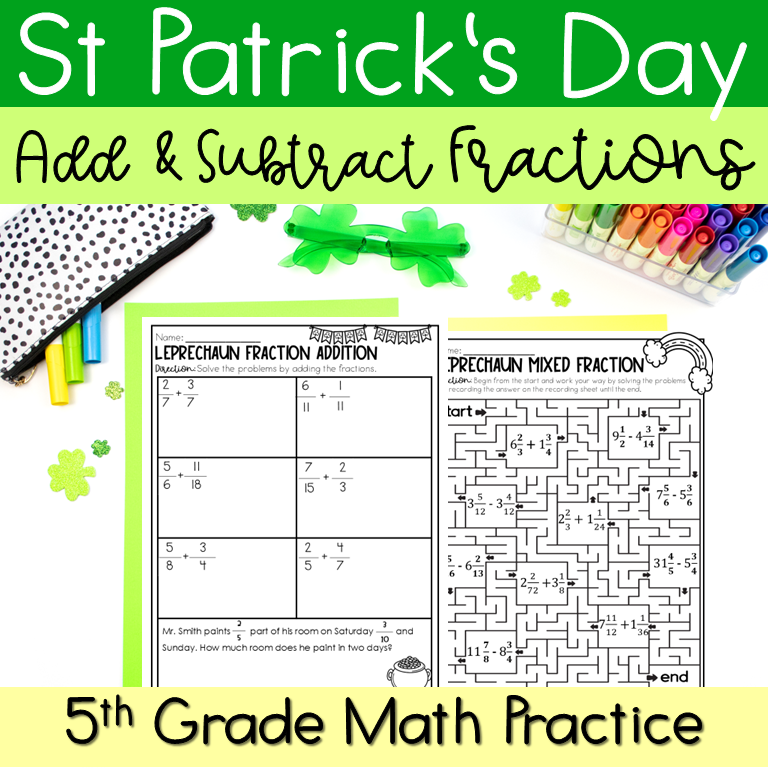
    Saint Patrick’s Day Fractions Operations Worksheets with Word Problems

    If you’re looking for a way to support your students with fraction addition and subtraction with unlike denominators without filling up your math centers with boring activities, I have the perfect solution!

    I have put together this packet of fraction review worksheets that you can use to review fraction operations that they have learnt this year.

    Saint Patrick Day Math Fractions Activities with unlike denominator for upper elementary students

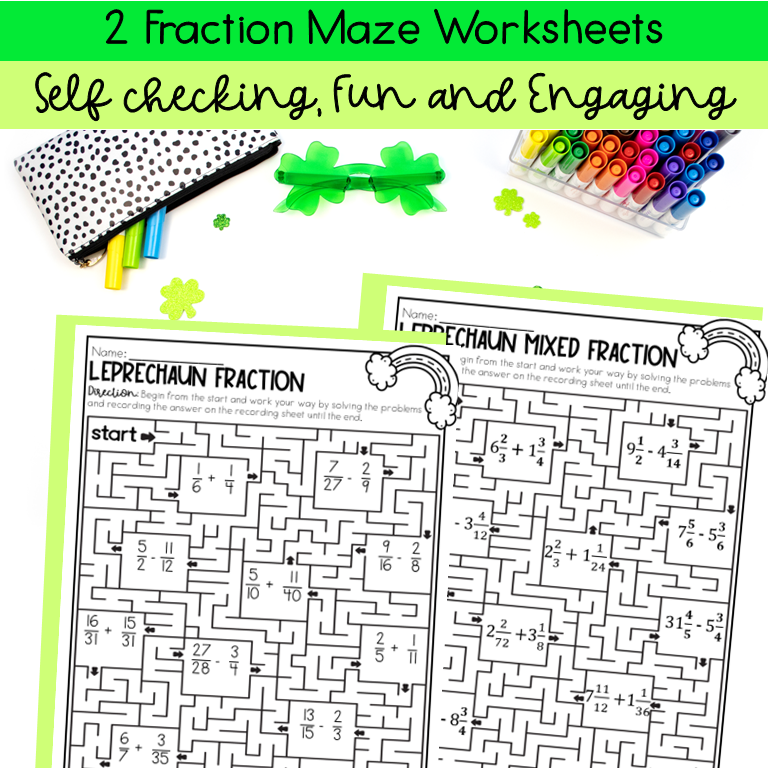
    The pack not only includes fraction review worksheets, but also includes self-checking mazes and a word search you can use for the early finishers in your class.

    Do not need something to practice, but rather need something to test their knowledge?

    The packet also includes 2 pages of multiple-choice question-style worksheets you can use as an assessment to test their understanding.

    One thing I love about this packet is that it includes a whole lot of ways I can get them to practice fraction addition and subtraction.

    So, whether they’re asked to solve addition and subtraction of fractions, these worksheets will keep them engaged, challenged, and entertained throughout their math journey.

    But wait, there’s more! The pack is best equipped with so much more fun like word search and coloring fun.

    You can keep a set of these activities copied at your small group table and pull out the most appropriate one you need for each group to try. 

    Saint Patrick’s Day Math Coloring Worksheets

    These math coloring pages are also a great tool for increasing student independence at centers time or during morning work.

    If you are practicing math multiplication or division facts and need them to go beyond and try multidigit multiplication or division, you can do that by using these Saint Patricks activities during their centers.

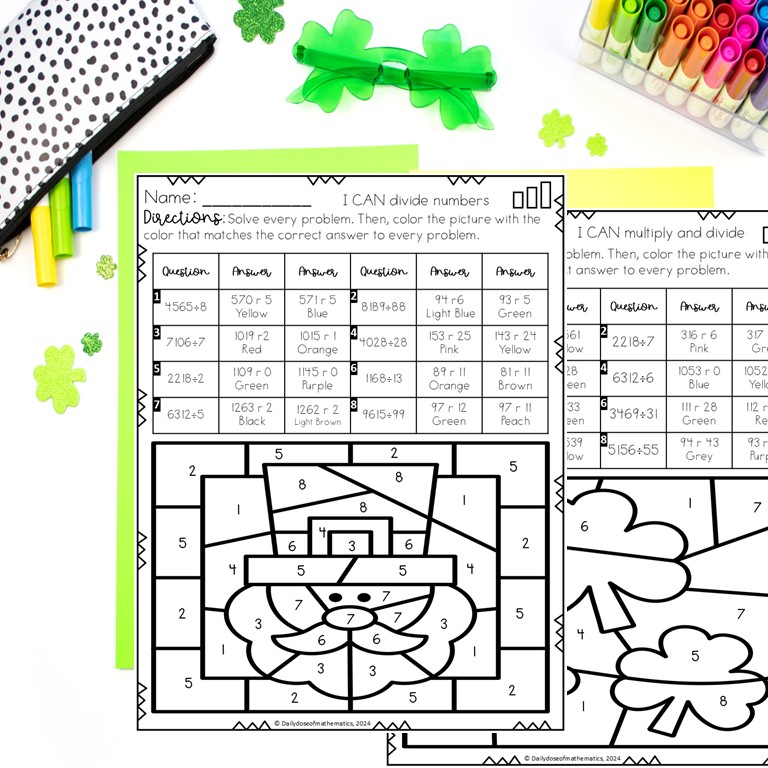
    Adding Subtracting Multiplying and Dividing Whole Numbers Coloring Color by Number Activity with Multi-digit Practice

    These provide an easy but rigorous practice to help kids be more independent in their basic whole number operations.

    So, why settle for boring math practice when you can add a splash of Saint Patrick’s Day magic to your lessons?

    Let’s make basic operations like addition and subtraction or even division fun, engaging, and unforgettable with these worksheets!

    St Patrick’s Day Decimal Operations Activity

    Are your students struggling with adding and subtracting decimals? It might not feel like a difficult skill to you but for 5th graders it’s a lot.

    The one concept I have seen students get stuck on is the idea of understanding the decimal place values. They usually align their numbers wrong, which then gives a wrong answer.

    So this March, if you want to help kids master decimal operations. Let them practice it in a way that is both meaningful and movement-based.

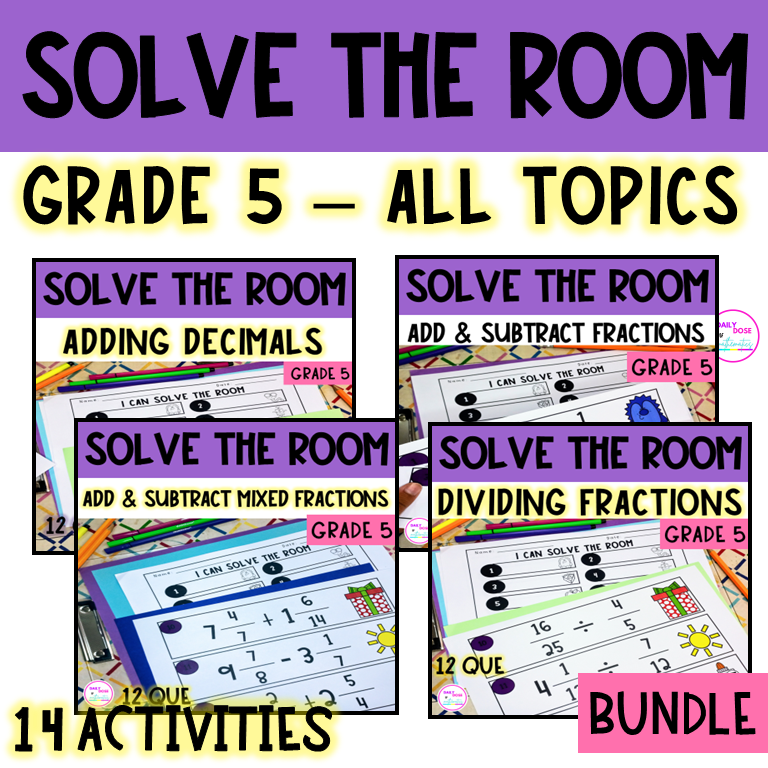
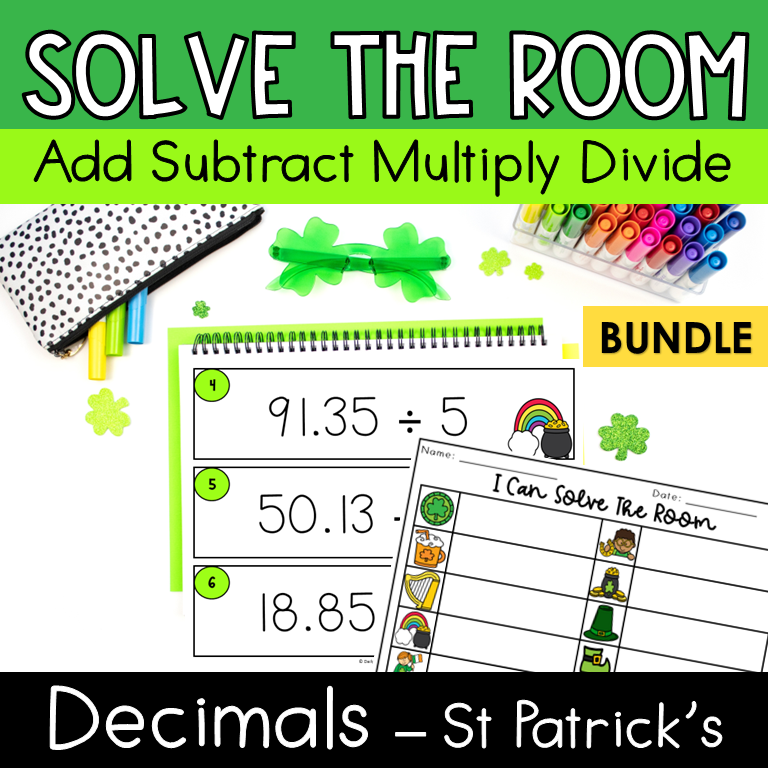
    5th Grade Adding Subtracting Multiplying and Dividing Decimals Math Practice Scavenger Hunt and Solve the Room Activity

    Saint Patrick’s Day Decimals Solve the Room Activity

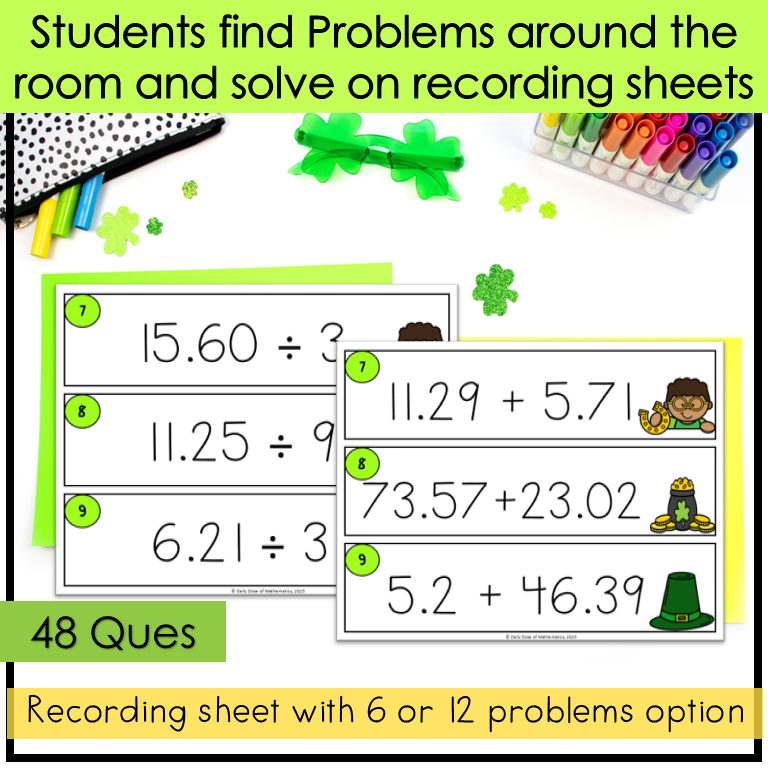
    Solve the Room activities are similar to scavenger hunts without the self checking part.

    Here is how it works:

    • Display the decimal problems inside classroom for kids to find
    • Students navigate the room and solve each problem
    • They engage in active learning, moving, and collaborating with their fellow
    • Record their answer on a recording sheet until all problems are done.
    Adding Subtracting Multiplying and Dividing Decimals Math Practice Scavenger Hunt 5th Grade Activity

    So, are you ready to turn your classroom into a math-filled treasure hunt this St. Patrick’s Day?

    Try these activities and make decimal operations an adventure to remember!

    Saint Patrick’s Day Secret Picture Puzzles

    For upper elementary students, repetition is key when it comes to learning multi digit multiplication and division.  They need plenty of practice with multiplication math fact fluency before they can master these skills. 

    In order to keep students engaged in multiplication and division, you need plenty of activities in our teacher toolboxes! 

    That’s why I wanted to share some hands-on March themed activities that your students will love!

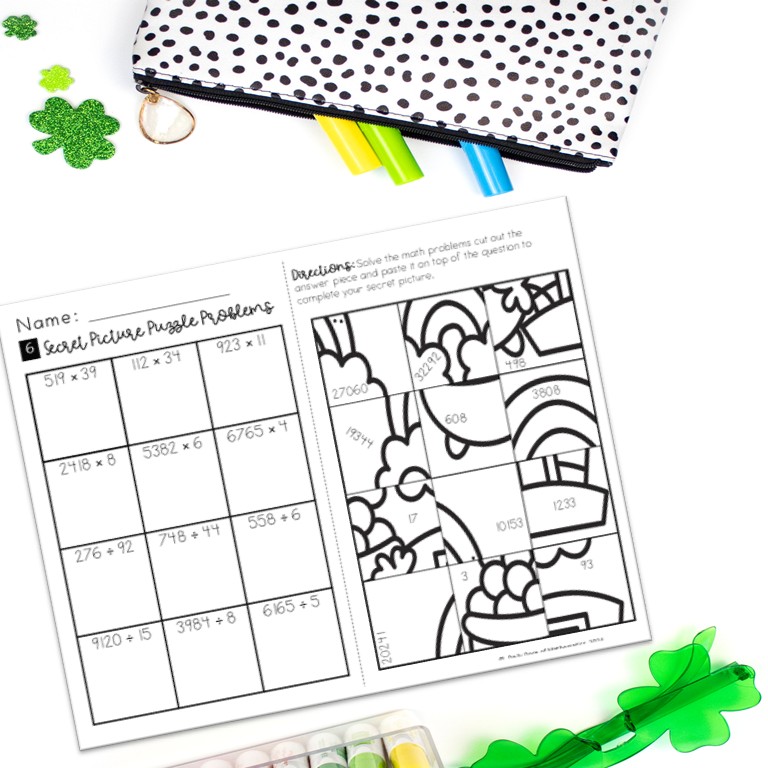
    If you’re looking for a hands-on way to help students practice multiplication or division, check out this mystery picture activity!

    St Patrick's Day Math Picture Puzzles Activity for 4th 5th Grade kids Multiplication and division practice

    All you need to do for this low-prep activity is print off the worksheet and cut out the puzzle pieces! You can cut them out yourself, or let your students cut them.  

    These secret picture puzzles can be used in many different ways, which is helpful for differentiation and engagement. 

    You can use these printable activities for math centers, morning work, small group practice, or even for fast finishers! 

    No matter how you decide to use these activities, your students will benefit from the extra practice with multiplication and division!

    St. Patrick’s Day Themed 5th Grade Math Craft

    Lastly, there are math crafts that are not just fun but also include common core-aligned practice so your students move forward in their math progress.

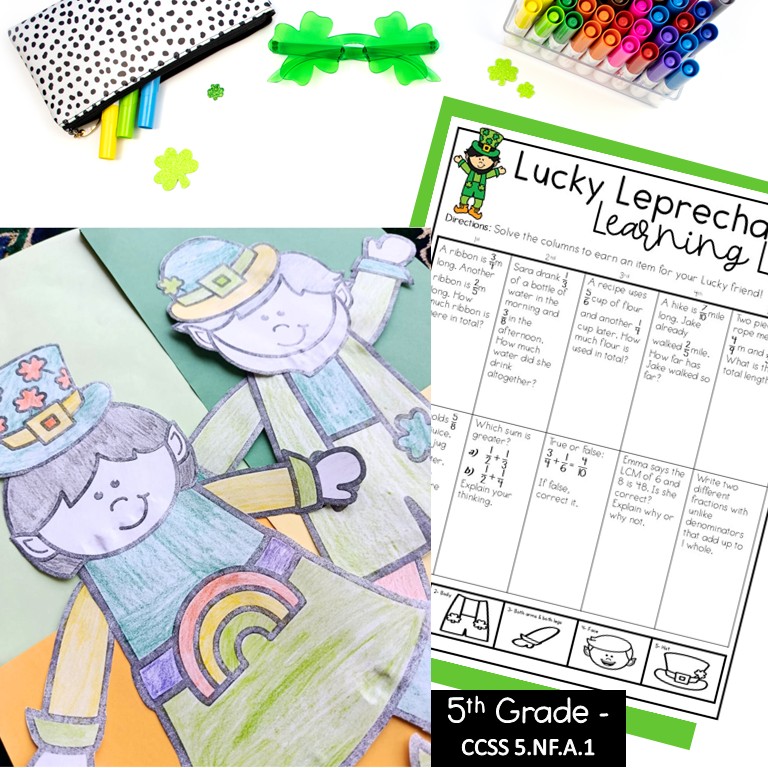
    This fraction math craft activity is perfect for centers because it is self-correcting and rewarding! 

    Students solve 3 math problems and come back to you to collect their craft item.

    Best St Patricks Day Math Adding and Subtracting Fractions Unlike Denominator Craft 5th and 6th Grade

    After checking their answers, the teacher hands them a craft piece that they have earned and will use to build their lucky leprechaun friend.

    It’s like a perfect reward-based activity kids need during this time of the year.

    Want something fun and free to use in your class check this Free Saint Patty’s day activities!

    Want to be set for the whole year of upper elementary math centers without paying your whole teaching salary. Check out this Mega Math Centers bundle currently at 75% off!

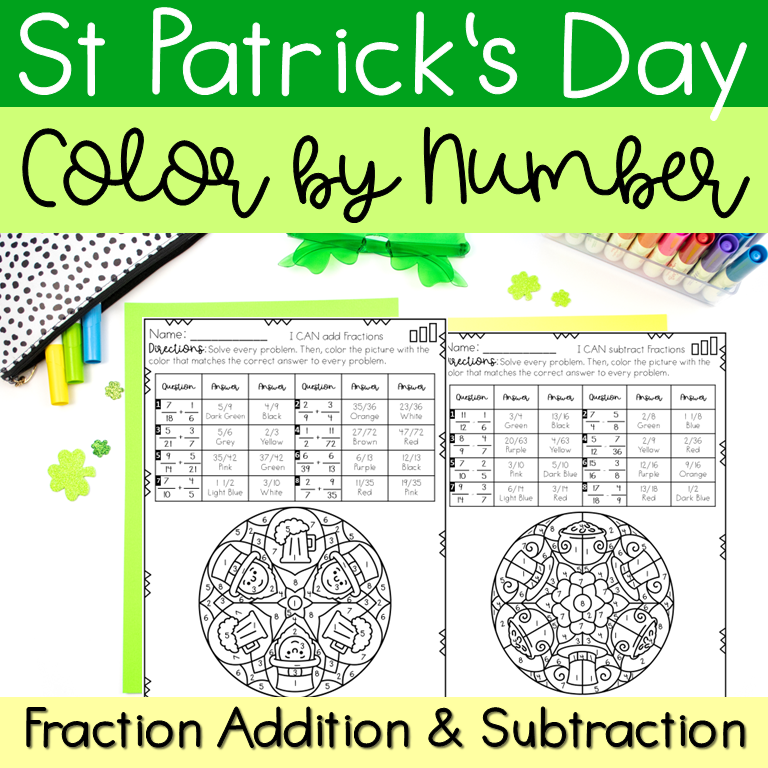
    St Patrick's Fraction Color by Number Math coloring activity
  • | | | |

    Best Saint Patrick’s Day Free Math Activity to use NOW

    Are you and your kids ready for some festive free fun St. Patrick’s Day spirit in your classroom?

    Solve the Room activities can be a very helpful resource for math practice and movement in you math classroom. 

    Upper elementary students greatly benefit from having a movement activity for basic math fact revision and practice what they have been learning.

    However, using old, boring math fact practice sheets can have a few drawbacks, which is why I’m sharing in this post.

    I think math teachers everywhere can agree that math fact fluency practice sheets can be very useful, especially when used as a pair activity.

    Students are more likely to recall multiplication facts they have learned when they have a timed reminder, such as 1 or 3 minutes. 

    But… the problem with these activities is that they are not super fun things you can try in your classroom, especially during seasons.

    This is the reason why, for me personally, this activity is something I use in my upper elementary math classroom whenever I feel like my kids need a break from their usual math learning and it’s time for some movement to keep students learning juice flowing.

    Multiplication Facts Math Practice Scavenger Hunt and Solve the Room Activity 0-9

    So if it feels like you are facing the same problem, then here are my top 3 reasons why you should use Saint Patrick’s Day themed Scoot activities in your math class along with some more fun math activities you might like:

    1. Encourages Movement and Interaction:

    The ‘Solve The Room‘ aspect of this activity adds a physical aspect to learning.

    Saint Patrick's Day decimal operation scoot practice activities | St. Patty's Day Adding and subtracting multiplying and dividing decimals for 5th grade

    Kids aren’t just sitting at their desks and practicing, instead, they’re moving around the classroom.

    This is even more beneficial for young kids in elementary or upper elementary who learn better when they’re physically engaged.

    2. Engagement through Theme-Based Learning:

    Themed activities are always a win in classrooms.

    Themed seasonal activities like Saint Patrick’s Day Math, are a fantastic way to keep students engaged.

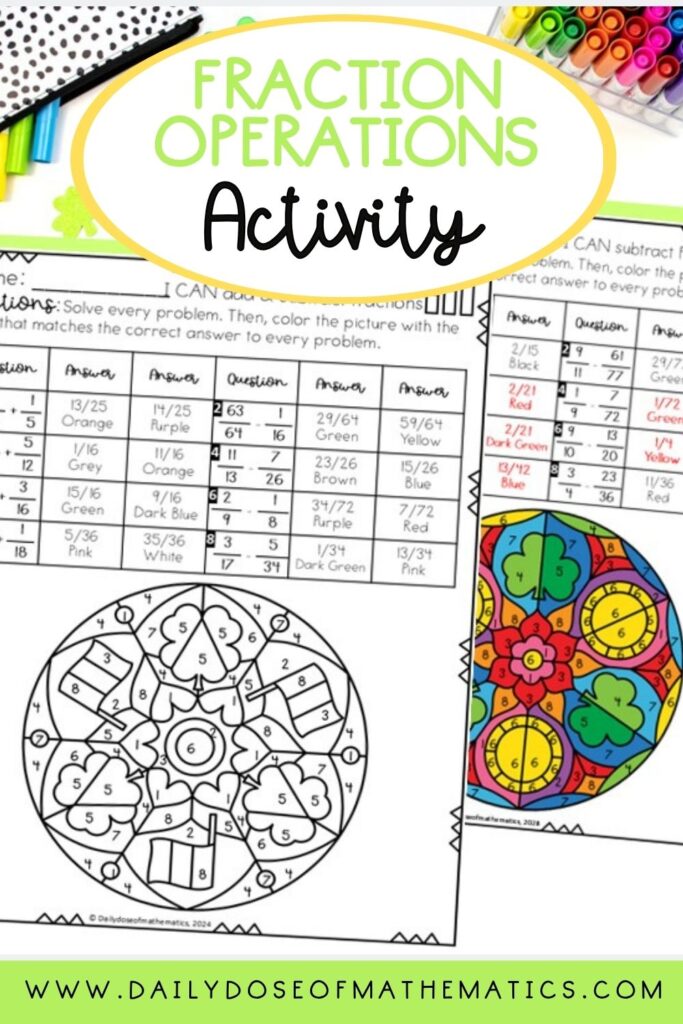
    Saint Patrick's Day fraction operation color by number coloring worksheets and activities | St. Patty's Day Adding and subtracting fractions

    Using these activities we will integrate the fun and festive spirit of the holiday into our March math lesson plans.

    This will not only capture student’s interest but make learning math more enjoyable for them.

    3. Promoting Collaboration and Social Skills:

    With all the rise in the use of technology for learning, kids are being glued to their screens a lot.

    These activities allow them to think outside the box and build their creativity muscle.

    Now… it isn’t just about math; it’s also about working together and developing social skills.

    Saint Patrick's Day fraction operation color by number coloring worksheets and activities | St. Patty's Day Adding and subtracting fractions

    Your kids can work in pairs or small groups which encourages teamwork and communication.

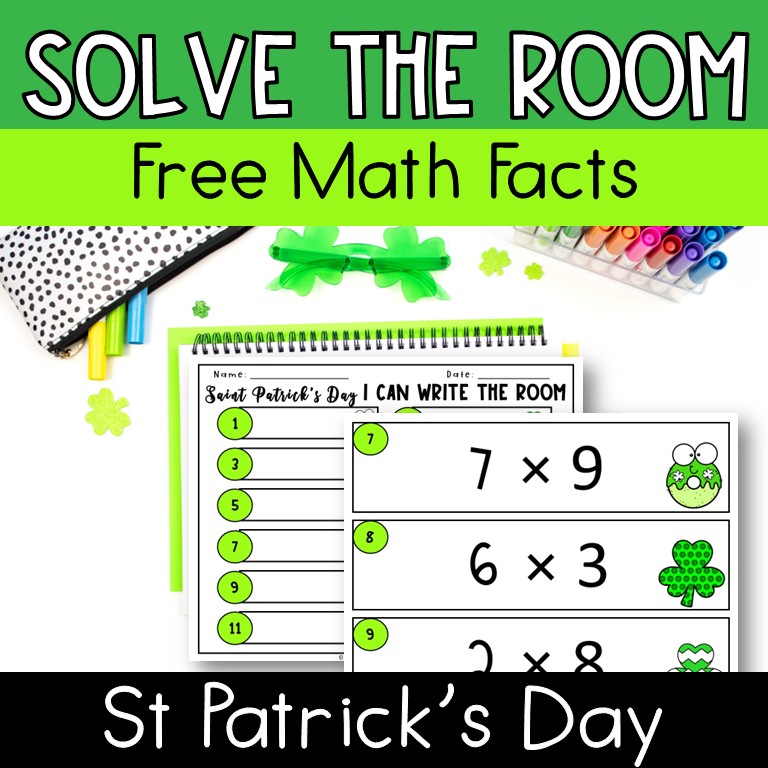
    Want to use the free solve the room activity inside your classroom? Click here and get the freebie activity.

  • | |

    Fun Division Riddles for Practicing Division Skills

    Division is hard for kids…PERIOD!

    But it doesn’t have to be if its practiced with something fun like riddles.

    Honestly, when I first started out teaching… division always felt like a confusing jumble of numbers because didn’t have their facts memorized. 

    No matter how much you try to make your kids practice division problems unless they have a solid grasp of math facts they won’t be able to work on those complex problems.

    It’s like not knowing how to drive but trying to drive anyway.

    Division Riddles Worksheets and Activities for 3rd 4th and 5th grade math lessons -Pin

    If that’s the case, then what we should be focusing on is helping them get their basic math facts straight.

    By fifth grade, students should be proficient in basic math facts but if that’s not the case, there’s a problem.

    To be honest, there can be many reasons for this problem. 

    Reasons like

    • a lack of understanding,
    • memorization feeling like a draining task,
    • table overload,
    • multiplication confusion,

    and more can all contribute to elementary kids not having a good grip on facts.

    Are you interested in knowing how I make division practice fun and engaging for my kiddos?

    Without making it seem like they are practicing… It’s by using riddles!

    Riddles are a perfect teaching tool to help students develop division and problem-solving skills during back-to-school time or throughout the whole year.

    Why Division Practice Is Important

    Practicing division problems is crucial for a kid’s basic math learning and understanding.

    It’s like a foundational math skill that helps kids make sense of math.

    When children practice division, they learn how to break things into equal parts and understand the relationship between multiplication and division.

    This reinforces their number sense, basically how they see and work with numbers in daily life.

    It also helps them solve real-world problems.

    Let’s say, they’re cutting a pizza into slices or figuring out how many cookies each friend gets, knowing how to divide makes it easier for them.

    The most important thing is, it opens doors for advanced topics like fractions, ratios, and algebra later on grades.

    Ina nutshell, division helps kids:

    • Increase their problem-solving abilities 
    • Build confidence in handling day to day calculations 
    • Improve their understanding of the world around them

    Now that you know how important it is for our kids to practice division problems. Let’s talk solutions.

    The best way I am able to get my students working on division practice is by using division riddles.

    They keep kids focused on the task at hand and builds perseverance. 

    How Division Riddles Works: 

    You hand out one of the division riddles to your kids.

    It could be a division fact or 2 by 1, 2 by 2  digit or 3 by 1 or 3 by 2 digit, whatever numbers you want your students to practice that day. 

    Students start working on the problems and with every problem they unlock a key (letter) that is part of the mystery riddle they are solving.

    The clues are unlocked randomly to make it more interesting and exciting for the kids.

    Division Riddles Worksheets and Activities 3rd 4th 5th grade elementary kids fun division practice sheets

    Once they have solved all the problems the answer to the mystery is revealed.

    This gamified way of practicing division makes it less intimidating for the students and helps them gain confidence in their math skills.

    Few ways to use Division Riddles inside classroom:

    We all love activities that are versatile and can be used in multiple ways inside our classroom.

    Here are a few ways you can use a Riddle activity 

    • Partner work
    • Home work
    • Centers or rotation
    • Review or practice work
    • Or anytime you want to have something FUN 

    By the way if you are looking for 2 and 3 digit by 1 digit long division practice worksheets for your upper elementary students? 

    Check out the division riddles resource on my TPT shop and let your kids have fun while learning at the same time.

    Division Riddles Worksheets and Activities 3rd 4th 5th grade elementary kids fun division practice sheets-pin

    Looking for more tips on 5th grade math teaching checkout this Blog post on 5th grade year round math activities.

  • |

    The Only Multi-digit Addition and Subtraction Practice I’ll Use This Year

    Raise your hand if you’ve ever printed a math worksheet, handed it out and watched your entire class immediately ZONE OUT. 

    Same. Dry, black and white worksheets suck the energy right out of math time for your students and for you.

    They’re boring. They don’t work. And worst of all? They make these core basic operations reviews feel like a chore. 

    But here’s the thing, addition and subtraction practice doesn’t have to be dull. 

    When you mix in color by number printables or activities with riddles to review, your kids are engaged, your classroom is calm, and your math centers become something everyone actually looks forward to.
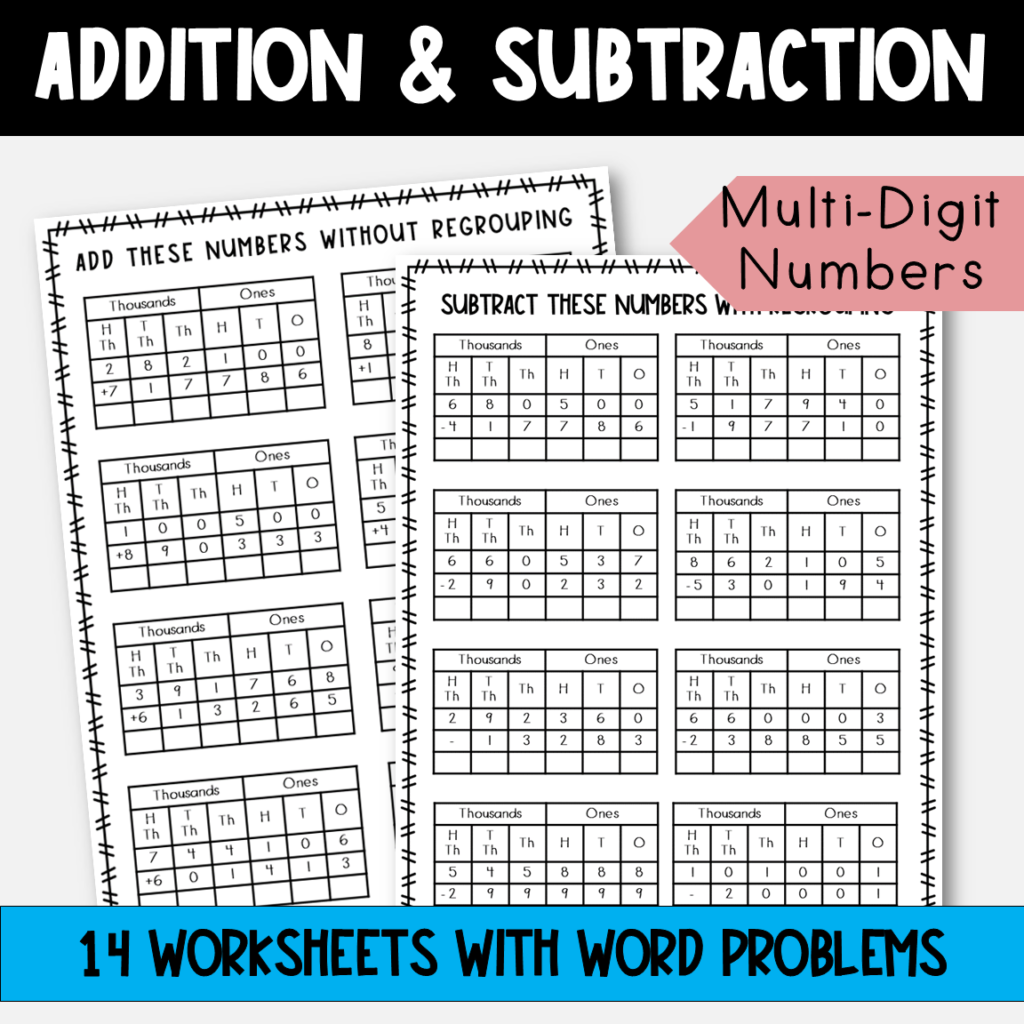
    I’m breaking down the multi-digit addition and subtraction practice worksheets I’ll use this year, because they work and they save my sanity.

    Strategy 1: Use Multi-digit Addition and Subtraction Escape Room to Make Practice Fun

    What would life be like if you didn’t have to convince kids that the more they practice, the better it is for them?

    What better way to practice than to disguise it as a riddle and increase their curiosity along with math skills? These are just a few of the reasons why math riddles are magic, I use during review time.

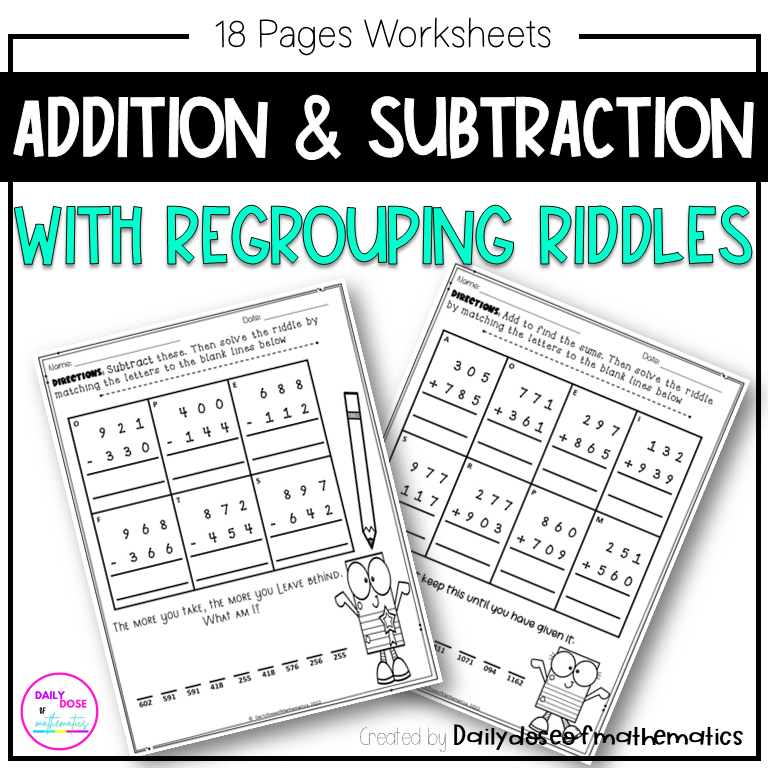
    The only 2 and 3 digit Addition and Subtraction Practice Activity Needed in your elementary math class | Multidigit Addition and Subtraction Escape Room printable worksheets activity for 3rd 4th and 5th grade

    My students get self motivated to solve them, and that’s not just to get the math right but to solve the riddle. That little “aha” moment at the end makes the work feel like a game to them, not a worksheet.

    The best part? Riddle worksheets are also self-checking. If the answer doesn’t make sense? It means it’s time to double-check their math without you having to hover or correct them. The reason why it’s a total win for me. 

    Escape Room-style riddles are also perfect for independent work, partner pairs, or small groups. 

    The only 2 and 3 digit Addition and Subtraction Practice Activity Needed in your elementary math class | Multidigit Addition and Subtraction Escape Room printable worksheets activity for 3rd 4th grade

    You’ll love the classroom management piece (hello, quiet engagement), and your students will love cracking the code.

    Still not sure? Try what I use and see your kids filled with excitement: Multi-Digit Addition and Subtraction with Regrouping Escape Room.

    Want to try a free activity? Grab my FREE addition and subtraction printable pack from my TPT store here. It’s ready to print and go. 

    Strategy 2: Color by Number for Fluency & Focus

    You know those kids who can’t sit still for more than five minutes? Yeah, even they get into color by number math. The visuals pull them in, and the structure keeps them focused. It’s like sneaking in math fluency practice… with crayons.

    To be honest color by number is a game-changer for independent work, early finishers, math centers, basically anytime you need your students to be engaged without needing your constant attention.

    And unlike flashcards, these worksheets build fact fluency in a low-stress, low-prep way that students actually enjoy. 

    My go-to resources that I pull again and again are: Add/Subtract/Multiply/Divide Color by Number Worksheets

    My students actually ask for these during math review. Yep. It’s that fun. 

    Strategy 3: Mix Seasonal + Skill-Based Review

    Want to keep review fresh without re-inventing the wheel every week? 

    Seasonal printables are your best bet. You’re still hitting the same addition and subtraction skills, just dressed up for fall, Halloween, winter, or whatever season you’re in.

    Students stay engaged because it feels new even though the practice is familiar. Teachers win because it’s low-prep and high-impact. 

    It’s perfect for early finishers, homework, and sub plans basically anytime you need a minute to breathe.

    Teachers like you find these a fun addition to their toolkit: any seasonal or holiday themed addition and subtraction practice.

    What would life be like if you didn’t have to reinvent the wheels? 

    If you want your students engaged, confident, and actually enjoying math this year, start with tools that make them smile and think. Riddles, color by number, seasonal printables, they’re more than just fun. They’re effective.

    You don’t need to reinvent math review. You just need the right tools in your teacher box. 

    Still want to learn more?

    Check out this back to school math activities that set the tone for your whole year.